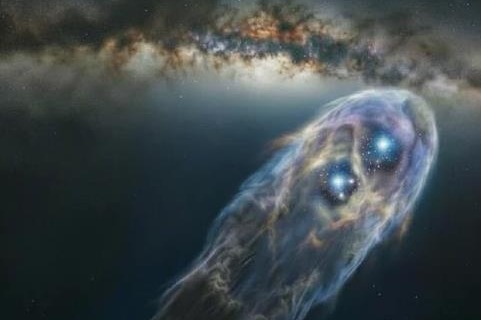
In a landmark astronomical discovery, researchers from China West Normal University have identified two exceptionally young star clusters located approximately 45,000 light-years from Earth in the peripheral regions of the Milky Way galaxy. Designated as Emei-1 and Emei-2, these celestial formations represent what scientists are calling ‘baby star clusters’ due to their remarkably recent emergence in cosmic terms.
The findings, published in the prestigious journal Nature Astronomy, reveal that these clusters originated approximately 11 million years ago from a violent collision between two dense gas clumps within a high-velocity gas cloud streaming toward our galaxy. Associate Professor He Zhihong, the paper’s lead author, explained that the intense pressure generated by this cosmic impact created an extremely compressed environment that triggered the star formation process.
What makes this discovery particularly significant is its challenge to conventional astronomical understanding. Previously, astronomers observing high-velocity clouds could detect only gaseous matter without any stellar components. The Emei clusters provide the first concrete evidence that such clouds can indeed foster star birth under specific extreme conditions, fundamentally altering scientific perspectives on stellar formation locations.
Additionally, this breakthrough offers direct observational support for the theoretical framework suggesting that the Milky Way grows and nurtures new stars by accreting fresh gas from its intergalactic surroundings. The clusters’ distinctive blue coloration and exceptional brightness – characteristics of very young stars – further confirm their status as cosmic ‘newborns’ in the vast timeline of the universe.