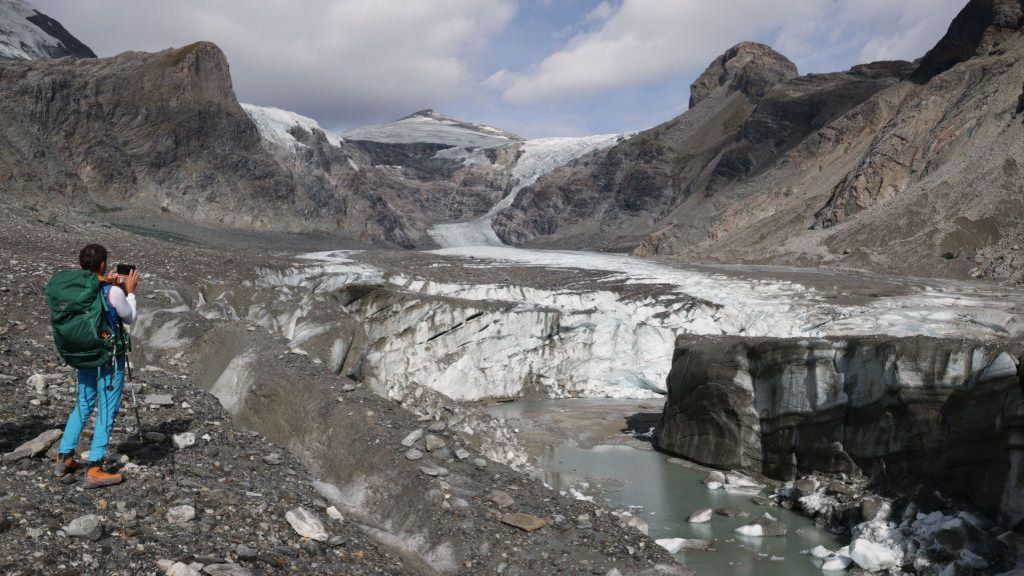
A dire climate emergency is unfolding across the Austrian Alps as new scientific evidence reveals glaciers are undergoing catastrophic structural disintegration rather than gradual shrinkage. The Austrian Alpine Club’s comprehensive annual report documents an alarming pattern of glacial collapse across the nation’s mountainous regions.
Researchers from the University of Graz have identified disturbing transformation patterns, with Professor Andreas Kellerer-Pirklbauer reporting: ‘We’re witnessing complete structural breakdown—exposed rock formations, massive ice sections fracturing, and glacier tongues collapsing inward. These phenomena are fundamentally reshaping alpine topography.’
The data presents a stark picture: 94 of 96 monitored glaciers significantly retreated during the observation period. The most severely affected include Tyrol’s Alpeiner Ferner, which receded by 114.3 meters, and Salzburg’s Stubacher Sonnblickkees, diminished by 103.9 meters. Even Austria’s largest glacier, Carinthia’s Pasterze, faces imminent fragmentation as its tongue prepares to detach, potentially splitting the massive ice formation in two.
Climate scientists attribute this accelerated deterioration to consecutive extreme weather events. The combination of snow-deficient winters and exceptionally warm early summers—with June temperatures nearly 5°C above historical averages—has created devastating conditions for glacial preservation. High-altitude monitoring stations consistently recorded temperatures 2°C above long-term norms.
Gerhard Lieb, co-director of glacier monitoring services, emphasized the irreversible nature of these changes: ‘Current mass loss has reached critical levels where glaciers can no longer recover during brief cooling periods. The transformation has become self-sustaining.’
The implications extend far beyond landscape aesthetics. Nicole Slupetzky, Vice-President of the Austrian Alpine Club, underscores the urgent need for adaptation: ‘Climate impact is our present reality, not a future concern. The debate has shifted from glacier preservation to managing consequences for human infrastructure and communities.’
Researchers warn that disappearing glaciers will fundamentally alter water systems, increase natural hazards, and threaten alpine infrastructure, marking a permanent transformation of one of Europe’s most iconic landscapes.