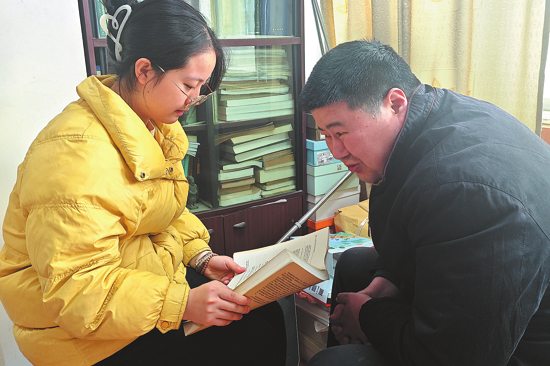
In the quiet confines of a Wuchang district residence in Wuhan, an extraordinary academic pursuit unfolds daily. Zhou Shun, who lost his vision during childhood, has transformed his modest living space into an intellectual sanctuary where advanced mathematics and physics concepts come alive through auditory learning and tactile imagination.
Initially attributed to congenital retinal atrophy, Zhou’s condition was later accurately diagnosed as retinitis pigmentosa – a cluster of inherited retinal disorders that progressively diminish eyesight. Rather than retreating from scientific exploration, Zhou developed innovative cognitive approaches utilizing sound, logical reasoning, and mental visualization to comprehend complex scientific principles.
For over three decades, Zhou has collaborated with volunteer readers from Wuhan University who patiently articulate mathematical formulas and scientific diagrams. This sustained academic partnership has enabled him to construct what he describes as an intricate ‘universe of knowledge’ within his mind.
His intellectual achievements culminated in December with the publication of his third scholarly work, ‘Mathematics in Physics,’ an expanded edition building upon his 2017 original publication. The treatise demonstrates remarkable breadth, spanning from fundamental undergraduate concepts like calculus and linear algebra to advanced graduate-level topics including spectral theory on infinite-dimensional vector spaces and tensor analysis.
Professor Zhou Bin of Beijing Normal University, specializing in field theory and general relativity, noted in the book’s preface that the work presents substantial challenges even for mathematically trained master’s degree candidates.
Those who work closely with Zhou emphasize his unique cognitive abilities. Chai Chengye, a third-year physics undergraduate at Wuhan University who began reading for Zhou in 2023, observed: ‘While we rely on blackboards for visualization, Zhou utilizes darkness as his canvas – projecting equations, formulas, and theoretical conjectures through a mind sharpened to extraordinary precision.’
Zhou’s story transcends individual achievement, serving as powerful testament to human perseverance and the transformative potential of adaptive learning methodologies. His journey continues to inspire both disabled learners and academic professionals, demonstrating that intellectual boundaries can be redefined through determination and innovative thinking.