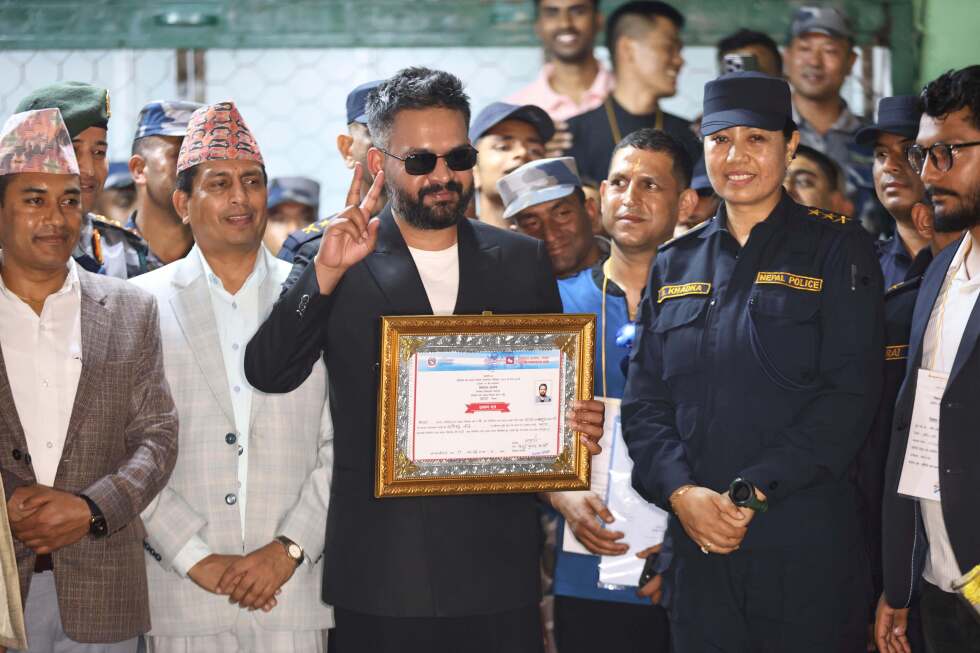
KATHMANDU, Nepal — Nepal’s political establishment has been dramatically upended by the stunning electoral triumph of the Rastriya Swatantra Party (RSP), a four-year-old political movement led by former rapper Balendra Shah. Official results released Thursday by Nepal’s electoral commission confirm the party’s overwhelming victory in the nation’s first parliamentary elections since last year’s youth-led uprising.
The RSP secured a commanding majority in the 275-seat House of Representatives, capturing 125 directly elected seats and an additional 57 through proportional representation. This gives the party a total of 182 seats, far exceeding the 138 needed for a simple majority. The previously dominant Nepali Congress party trailed distantly with just 38 seats.
Nepal’s electoral system combines direct voting for 165 parliamentary seats with proportional representation allocating the remaining 110 seats based on party vote share. The electoral commission will now formally request party nominations to fill proportional representation seats before presenting the final composition to the president.
This procedural phase, expected to require several days, will culminate in the convening of the new parliament and the election of a prime minister. With nearly two-thirds of parliamentary seats, RSP leader Balendra Shah—the party’s prime ministerial candidate and 2022 Kathmandu mayor—is positioned to assume leadership.
The RSP’s remarkable ascent represents a direct challenge to Nepal’s traditional political powers, particularly the Nepali Congress and Communist Party of Nepal (Unified Marxist–Leninist). The party capitalized on widespread discontent with corruption and governance failures that sparked last year’s protests, which began as opposition to social media restrictions before escalating into full-scale antigovernment demonstrations. The unrest resulted in dozens of fatalities and hundreds of injuries amid clashes between protesters and security forces.
Shah emerged as a prominent figure during the 2025 uprising that ultimately toppled former Prime Minister Khadga Prasad Oli’s government. His transition from musical artist to political revolutionary has now culminated in an unprecedented electoral mandate that signals a profound transformation in Nepal’s political paradigm.