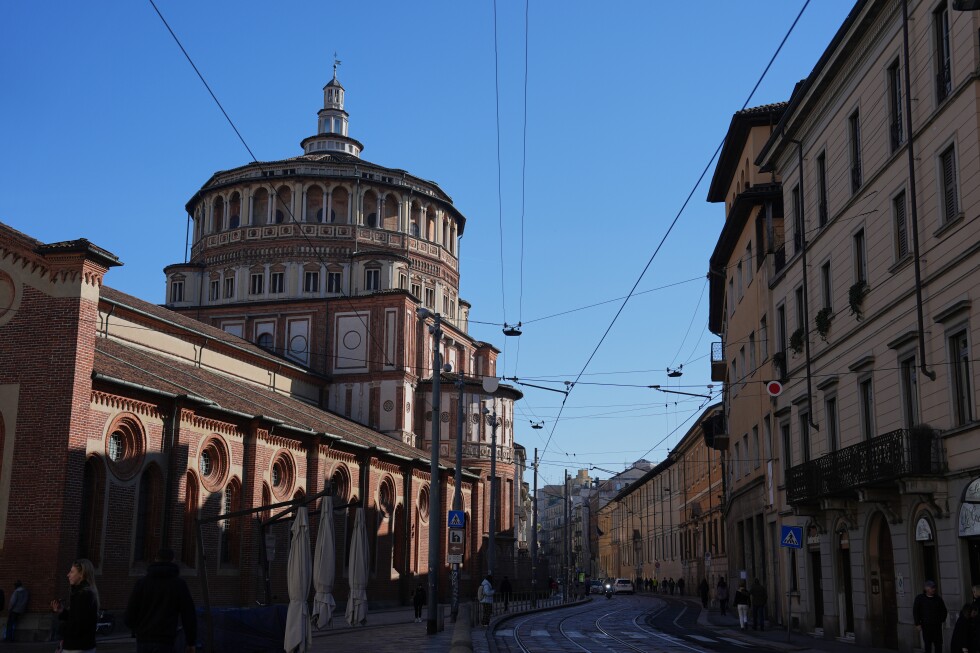
Within the hallowed walls of Santa Maria delle Grazie in Milan, a living Dominican community maintains its spiritual practices just steps away from one of art history’s most celebrated masterpieces. While Leonardo da Vinci’s “The Last Supper” draws countless visitors to the former refectory, twelve priests and nine novices continue their monastic traditions in the adjacent basilica and convent.
The current friars, including Reverend Paolo Venturelli, experience the famous mural from a unique perspective. Venturelli prefers to view the painting from across the room where it was originally created in the 1490s at the request of Milan’s ruler Ludovico Sforza. “From there, the painting looks as though it were painted in the middle of the refectory,” Venturelli observes. “It unleashes all kinds of human and spiritual reactions.”
Historical circumstances have created a physical separation between the friars and the artwork that was originally created for their order. Following Napoleon’s suppression of religious houses in the 18th century, the refectory passed into state control. Today known as the Cenacolo Vinciano, it is managed by Italy’s Regional Directorate of Museums of Lombardy. “We don’t go often because we have to ask permission to enter,” Venturelli explains, noting that preservation rules limit visits to just 15 minutes for everyone, including friars. “It no longer belongs to us.”
The Dominican community maintains an active religious presence despite the tourist crowds. Dressed in their iconic white robes or brown winter capes, the friars are regularly seen within the basilica. Many visitors who come specifically for Leonardo’s masterpiece also discover the spiritual significance of the adjacent church. “We came to see Leonardo’s Last Supper but we also wanted to see the church because it’s quite special,” noted Maria Teresa Bruzzi, a recent visitor from Genoa.
The friars provide multiple services to both locals and tourists, including confessions in several languages. Reverend Llewellyn Muscat, prior of the community, explains: “Confessions are very much sought after and we maintain this service for the citizens of Milan but also for all visitors.” The friars accommodate speakers of Italian, English, Maltese, French, and German.
The intellectual legacy of the Dominicans remains evident throughout the convent, where halls contain dozens of shelves filled with books. “Reading is part of our identity,” Muscat emphasizes. The friars follow a routine shaped by study, prayer, and ministry, with some teaching at local Catholic institutions or collaborating with the cultural center that organizes conferences and events.
For the Dominicans, “The Last Supper” represents more than artistic achievement—it embodies their continuing spiritual connection. “For us, it does not awaken an emotion about something that belongs to the past,” Muscat reflects. “It is like a continuation in which we eat together with Jesus and his apostles, as though his words are also spoken to us.”
The current refectory where the friars actually dine is located deep within the convent’s labyrinth-like structure, away from tourist traffic. It features several square tables rather than the long table depicted in Leonardo’s masterpiece. While appreciating their functional dining space, Muscat acknowledges the community’s historical connection to the famous painting: “Maybe one day the old refectory will belong to us again.”