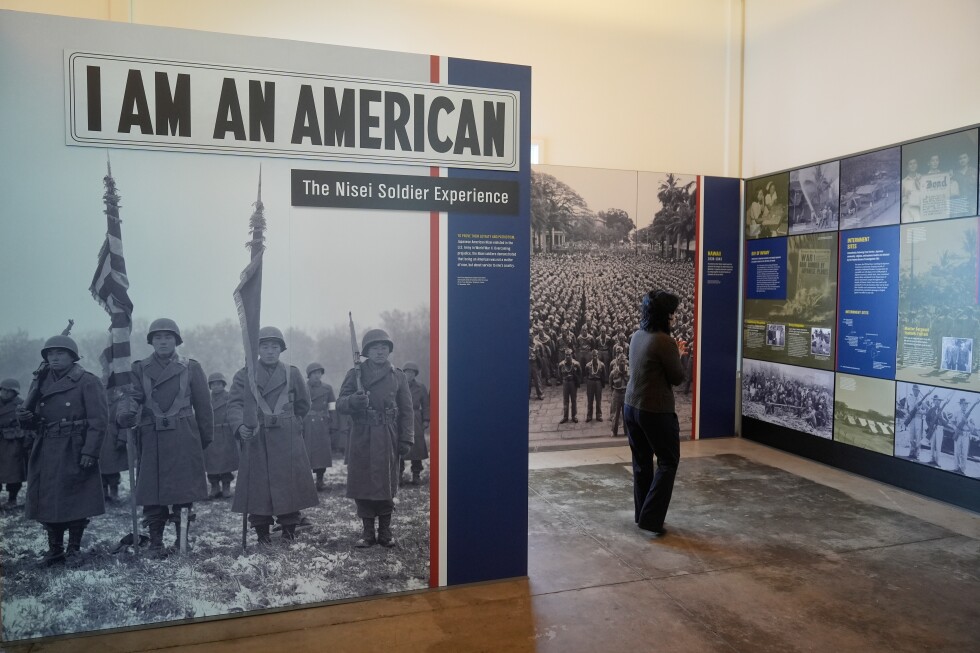
SAN FRANCISCO – A powerful new traveling exhibition titled “I am an American: The Nisei Soldier Experience” has launched in San Francisco, honoring the extraordinary legacy of second-generation Japanese American soldiers who fought for the United States during World War II while their families endured incarceration in government internment camps.
The exhibition’s title derives from a sign prominently displayed on a Japanese American storefront in Oakland, California, immediately following the Pearl Harbor attack. This 1,500-square-foot showcase presents intimate family photographs, personal mementos, and biographical profiles of Nisei soldiers, meticulously preserved by their descendants to ensure these narratives of courage and patriotism endure for future generations.
Among the poignant artifacts is a travel bag belonging to Sgt. Gary Uchida, adorned with his hand-drawn illustrations of his native Hawaii and various locations he visited during military service. The exhibition also features a U.S. Army identification card where Oregon-born George S. Hata unequivocally declared his nationality as “American.” Another remarkable item is a handmade note holder crafted by Rihachi Mayewaki from lumber scraps while imprisoned at the Jerome camp in Arkansas. This artifact displays an American bald eagle and a blue star banner with three stars representing each of his sons who served: Ben, who collected and interpreted enemy intelligence; Charles, who trained as a rifleman with the renowned 442nd Regimental Combat Team; and Hachiro, who worked as a military translator.
Approximately 33,000 Japanese Americans fought in World War II despite the U.S. government forcibly relocating an estimated 120,000 individuals of Japanese ancestry to remote internment camps. Many were elderly or children too young to comprehend accusations of treason, with two-thirds being U.S. citizens. Their properties and businesses were confiscated during their imprisonment in overcrowded, harsh conditions.
The exhibition highlights the story of Staff Sgt. Robert Kuroda, who enlisted after being denied employment in Hawaii solely due to his ancestry. Kuroda perished at age 21 during the liberation of the French town of Bruyères from Nazi occupation, posthumously receiving the Medal of Honor for destroying two enemy machine gun nests under heavy fire. His medal and recovered high school class ring, found by a French metal detector enthusiast in 2021 and returned to the family, are among the featured artifacts.
This five-year traveling exhibition, presented by the National Veterans Network in collaboration with the National Museum of the United States Army and the Army Historical Foundation, will visit ten cities including Honolulu, Los Angeles, and Portland following its San Francisco presentation at the Presidio through August.