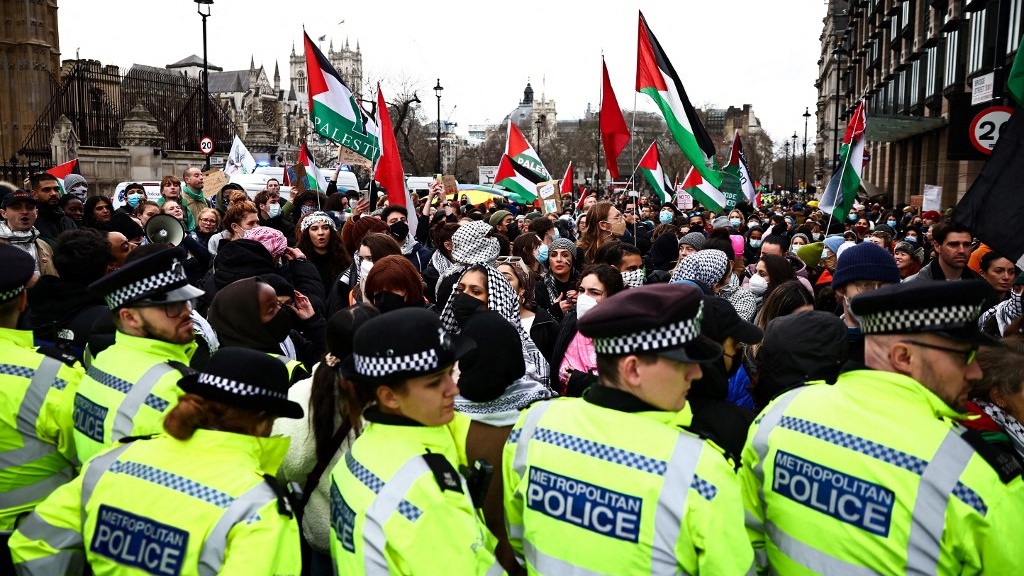
A pivotal legal confrontation unfolded in a UK courtroom on Thursday as government prosecutors pursued charges against prominent pro-Palestine activists for allegedly violating protest regulations. The case centers on Ben Jamal, Director of the Palestine Solidarity Campaign (PSC), and Chris Nineham, Vice-Chair of the Stop the War Coalition, who both entered not guilty pleas to charges stemming from a January 2025 demonstration in London.
Kevin Dent KC, representing the government, presented video evidence purportedly showing Jamal encouraging crowds to march toward BBC headquarters—an action prohibited under Metropolitan Police restrictions. Dent characterized this as deliberate incitement, stating “Mr. Jamal incited the crowd and indeed they did.”
The defense, led by Mark Summers KC, mounted a vigorous counter-argument declaring the police restrictions fundamentally “unlawful.” Summers referenced a Court of Appeal precedent limiting police powers to impose unlimited protest constraints. He maintained that Jamal’s speech contained no explicit encouragement to violate conditions, asserting “It is patently clear from the text of the speech that Mr. Jamal was not inciting anyone to breach conditions.”
The disputed protest was among more than twenty national demonstrations since October 2023 demanding Gaza ceasefires and criticizing UK support for Israel. While previous marches proceeded through central London, this gathering was confined to a static rally due to concerns about disrupting a synagogue’s activities.
Metropolitan Police Commander Adam Slonecki testified that while protesting outside the BBC was “legitimate” as a public institution, synagogue disruptions during Sabbath observances justified restrictions. The defense challenged police operational competence, presenting body-camera footage revealing officers using profanity and shouting “withdraw, withdraw” amid crowd pressure.
Summers argued this footage revealed “operational confusion, inconsistent communication and officers struggling to manage large numbers” rather than organized attempts to overwhelm police. The demonstration’s organizers denied allegations that protesters forcibly breached cordons.
The case emerged after pro-Israel groups, Chief Rabbi Ephraim Mirvis, and several MPs objected to the originally planned route past the BBC—a location chosen to protest perceived “pro-Israel bias” in Gaza coverage. The continuing trial represents a significant test case for protest rights and police powers in the UK.