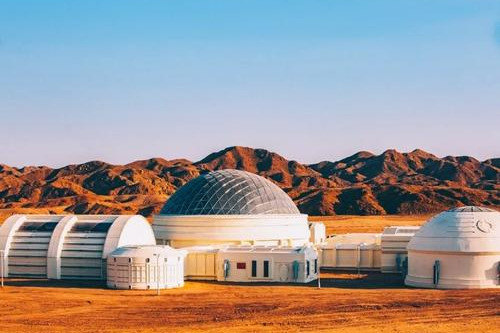
A pioneering Mars-themed educational tourism complex in China’s northwestern Gobi Desert has emerged as an unexpected hub for blending space exploration with traditional Lunar New Year celebrations, signaling a transformative shift in how modern families approach cultural holidays.
The Mars Base 1 Camp, strategically situated within the crimson-rock terrain of Jinchang, Gansu Province, has experienced remarkable visitor growth during the recent Spring Festival period. This innovative destination has successfully merged astronomical education with cultural preservation through cutting-edge technological experiences.
During the holiday season, the facility introduced a novel ‘cosmic blessings’ ceremony where participants attached handwritten wishes to miniature rocket models that were ceremonially launched into the desert sky. The base creatively integrated traditional dragon dances and lion performances against its otherworldly backdrop, while incorporating digital innovations including virtual lantern displays and augmented reality red envelope games.
According to municipal tourism authorities, the complex recorded approximately 503,000 visits throughout 2025, representing a near doubling of its previous year’s attendance figures. This growth trajectory positions the facility among the region’s most rapidly expanding cultural-educational tourism destinations.
Chen Guohai, Deputy Director of Jinchang’s Cultural and Tourism Bureau, explained the philosophical approach: “We’re reimagining traditional blessing rituals through aerospace technology, enabling visitors to experience festive customs within an interstellar context. This fusion represents how technological advancement can empower cultural tourism while preserving our heritage.”
Developed with collaboration from aerospace research institutions, the base stands as China’s inaugural immersive Mars simulation environment. Located merely thirty minutes from Jinchang’s urban center, the facility features meticulously designed habitat modules, rover replicas, and mission-oriented activity zones that replicate extraterrestrial living conditions.
Beyond its recreational appeal, the complex serves significant academic functions. Peking University’s School of Earth and Space Sciences has designated the Martian landscape simulation as an official multidisciplinary training base, enabling students to conduct field research and environmental simulations under extreme conditions.
Founder Bai Fan articulated the project’s dual mission: “Our objective centers on promoting public engagement with space science while establishing deeply immersive learning environments. Visitors can investigate simulated survival systems, examine hydroponic agricultural installations, and participate in realistic astronaut training exercises.”
The destination’s popularity underscores broader transformations within China’s tourism sector, where science-oriented, experiential attractions are increasingly driving cultural consumption patterns. Local authorities have strategically incorporated the base into regional Spring Festival initiatives that interconnect scenic attractions, winter sports facilities, and culinary promotions through discounted access programs.