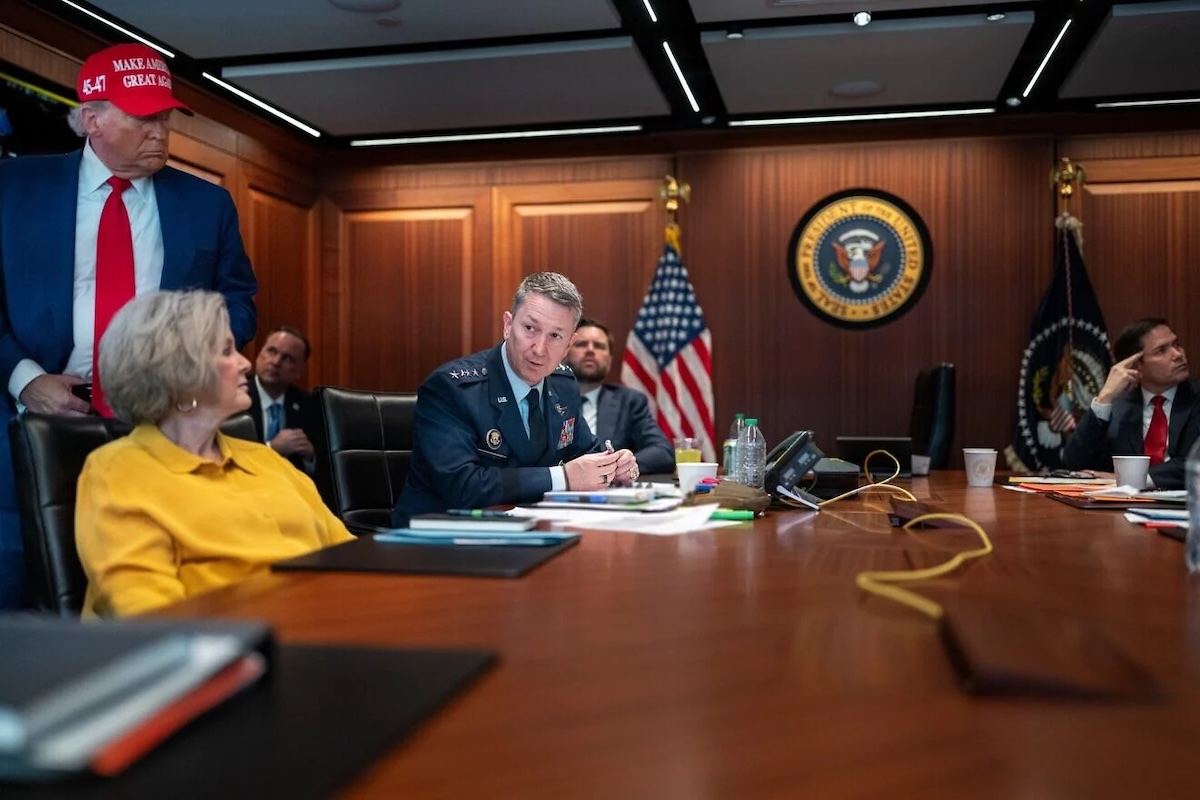
President Donald Trump conceded Monday that a U.S. military offensive against Iran would prove catastrophic for the Middle Eastern nation’s civilian population, even as his administration actively contemplates assault options. This admission emerged alongside reports indicating private cautions from General Dan Caine, Chairman of the Joint Chiefs of Staff, regarding the substantial risks associated with attacking Iran—a country of over 90 million inhabitants.
In a Truth Social post, Trump contested media narratives suggesting General Caine expressed reservations about potential military engagement. Contrary to these reports, Trump asserted that the general maintains a steadfast focus on victory, stating Caine would “lead the pack” if commanded to execute military operations. The president—who terminated a landmark diplomatic agreement with Iran during his initial term—added that failure to secure a new accord would result in “a very bad day for that Country and, very sadly, its people.”
This recognition of potential civilian devastation contrasts sharply with the rhetoric of war advocates who promote regime change as beneficial for Iran’s population. The National Iranian American Council emphasized the urgency of the situation, noting Trump’s own acknowledgment of dire consequences for Iranian civilians.
Legislative efforts are underway to prevent unauthorized military action, with the House of Representatives preparing to vote on a resolution requiring congressional approval for Iran engagement. However, the measure faces slim prospects of reaching the president’s desk. Recent polling indicates minimal public support for initiating conflict, with only 21% of Americans endorsing military action against Iran.
According to New York Times reporting, the administration is considering a phased approach involving initial targeted strikes followed by expanded operations if Iran refuses to abandon its nuclear program. Behind-the-scenes negotiations explore a potential compromise allowing limited nuclear enrichment exclusively for medical research purposes. This diplomatic initiative unfolds as U.S. military assets, including aircraft carrier groups and strike aircraft, mass within operational range of Iranian territory.
General Caine’s reported concerns extend beyond humanitarian considerations to practical military limitations. The Washington Post revealed the general warned that munitions stockpiles have been significantly depleted by ongoing support for Israel and Ukraine, potentially complicating any major operation against Iran.
The administration’s trajectory toward potential conflict has drawn substantial criticism from policy experts. Matt Duss of the Center for International Policy condemned prospective military action as “an illegal act of war,” noting the abandonment of previous justifications related to protecting Iranian protesters. Duss urged congressional intervention to clarify that the president lacks authorization for employing armed forces against Iran.