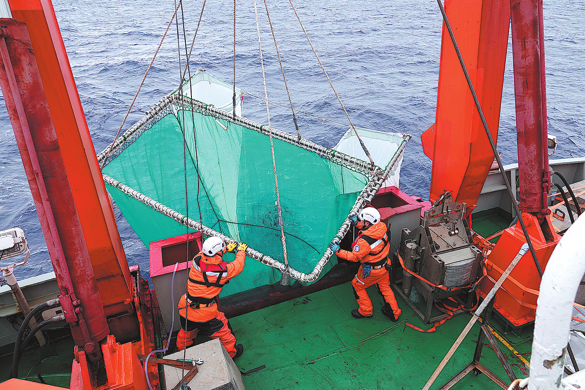
China’s polar research icebreaker Xuelong has successfully concluded its comprehensive oceanographic survey mission in Antarctica’s Amundsen and Ross Seas, marking a significant milestone in the nation’s 42nd Antarctic expedition. The scientific team deployed cutting-edge domestically developed technologies to conduct extensive research in one of the planet’s most climate-vulnerable regions.
The expedition, organized by China’s Ministry of Natural Resources, focused on the western Antarctic waters where ice sheets and shelves are experiencing accelerated melting due to global climate change. From January 2nd, researchers aboard the Xuelong (Snow Dragon) conducted multidisciplinary investigations encompassing hydrological conditions, marine biology, chemical composition, atmospheric conditions, and penguin habitats despite confronting severe weather challenges including intense winds, dense fog, and treacherous ice conditions.
Scientific leader Zhang Haifeng reported that the team executed sophisticated operations including the deployment and retrieval of moored buoy systems, innovative krill trawling techniques, and advanced conductivity-temperature observations. The research yielded particularly valuable specimens of Antarctic krill, midwater fish species, and deep-sea benthic organisms that will enable scientists to map the trophic structure of critical marine species and monitor population dynamics.
Team member Li Shuai highlighted technological breakthroughs including China’s indigenously developed polar ecological mooring system equipped with acoustic and optical detection modules capable of sustained underwater observation beneath ice cover. The expedition also introduced a newly enhanced multilayered krill trawl design that significantly improved catch efficiency and provided unprecedented data on krill distribution across water columns.
The 31-member scientific team, representing 12 Chinese research institutions and universities, will now proceed to Hobart Port in Australia before returning to China. Meanwhile, the Xuelong icebreaker continues to Zhongshan Station for additional research assignments, continuing China’s eight-year continuous multidisciplinary monitoring program in the Amundsen Sea that began in 2018.
Chief scientist Wei Fuhai emphasized that these long-term observational capabilities are essential for understanding the complex, rapid marine transformations occurring in this climate-sensitive region. The collected data will contribute significantly to global assessments of how climate change impacts polar marine ecosystems.