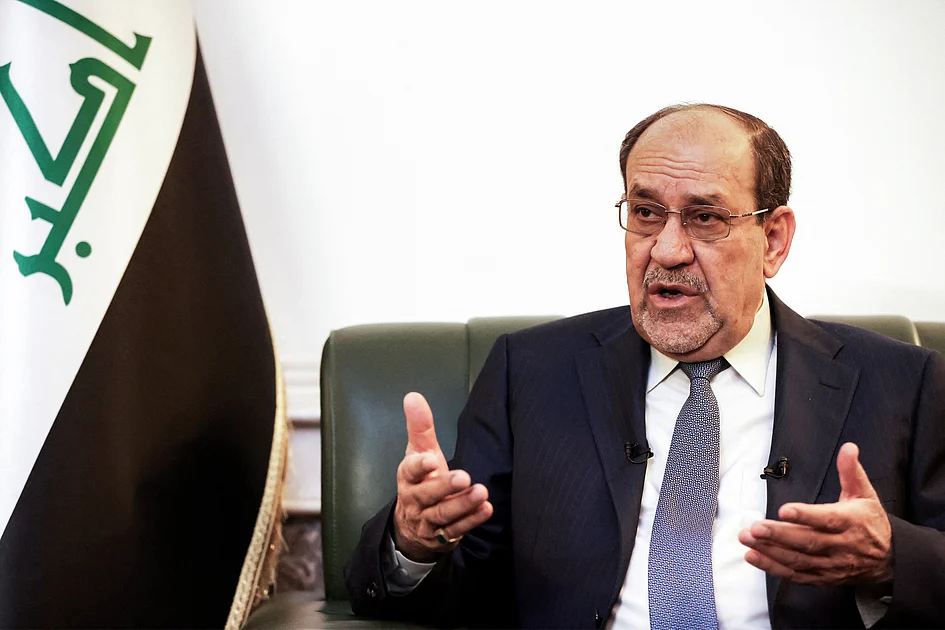
In a defiant stance against American diplomatic pressure, former Iraqi Prime Minister Nouri Al Maliki has publicly reaffirmed his commitment to pursuing the nation’s top political office. During an exclusive interview with AFP on Monday, the political veteran declared his unwavering determination to remain in the nomination process despite explicit warnings from the United States administration.
The political landscape in Iraq continues to be shaped by the complex interplay between global powers, particularly the ongoing rivalry between neighboring Iran and the United States. This geopolitical tension has persisted since the 2003 US-led invasion that deposed Saddam Hussein, creating a delicate balancing act for Iraqi leadership.
The current confrontation escalated last month when President Donald Trump issued an ultimatum stating that US support for Iraq would cease if Maliki—who maintains close ties with Iran—assumes the prime minister role again. This declaration has placed Iraqi leaders, particularly within the Coordination Framework (a ruling coalition of Shia groups with varying connections to Iran that nominated Maliki), in a challenging diplomatic position.
Maliki, who previously served two terms as prime minister from 2006 to 2014, responded to the American pressure with nationalistic rhetoric. ‘I have absolutely no intention of withdrawing out of respect for my country, its sovereignty, and its will,’ he stated emphatically. ‘No one has the right to say whom we can or cannot vote for.’
Addressing Washington’s concerns regarding Iran’s influence, Maliki presented a conciliatory tone while maintaining his position. He acknowledged that ‘countries have the right to set conditions in their dealings with Iraq,’ but emphasized that any alteration to his nomination would require action from the Coordination Framework, which continues to endorse his candidacy.
The former leader sought to reassure international observers by outlining his vision for military consolidation. ‘What America wants is not new. These are our demands,’ Maliki asserted. ‘We want weapons in the hands of the state. We want a centralized military force. We have said it repeatedly: we want one army under one command, directly under state authority.’
Maliki expressed optimism about reaching agreements with pro-Iran armed factions, noting that ‘there is a good basis for understanding’ that could be achieved without ‘force, war or confrontations.’ He believes these groups ‘do not want to expose Iraq to any danger.’
Regarding Washington’s demand to exclude Iran-backed armed groups from government participation, Maliki indicated this remains under discussion. He outlined a potential compromise: ‘We want those who participate in the political process and the government to lay down their arms. Those who lay down their arms are welcome to be part of the next government.’
With regional tensions escalating due to ongoing nuclear negotiations between the US and Iran, Maliki pledged to protect diplomatic missions in Iraq. ‘All countries can be assured that we will prevent any violation against their embassies or officially recognized interests in Iraq,’ he committed, referencing previous attacks on US facilities by Iran-backed groups.
Maliki defended Iraq’s relationship with Iran as based on mutual respect for sovereignty and shared interests, highlighting practical considerations including their 1,300-kilometer border and Iraq’s dependence on Iranian natural gas imports. He warned that cutting this supply ‘would be a major catastrophe’ for Iraq’s energy infrastructure.
Despite beginning to enjoy relative stability after decades of conflict, Iraq’s political future remains uncertain, caught between competing international interests and internal divisions that will challenge whoever ultimately assumes leadership.