The picturesque town of Yelets, located 350km south of Moscow, presents a stark contrast between its traditional charm and the grim realities of Russia’s prolonged military engagement in Ukraine. Beneath the golden domes of Orthodox churches and scenes of ice fishermen on the frozen river, the community grapples with the war’s profound consequences.
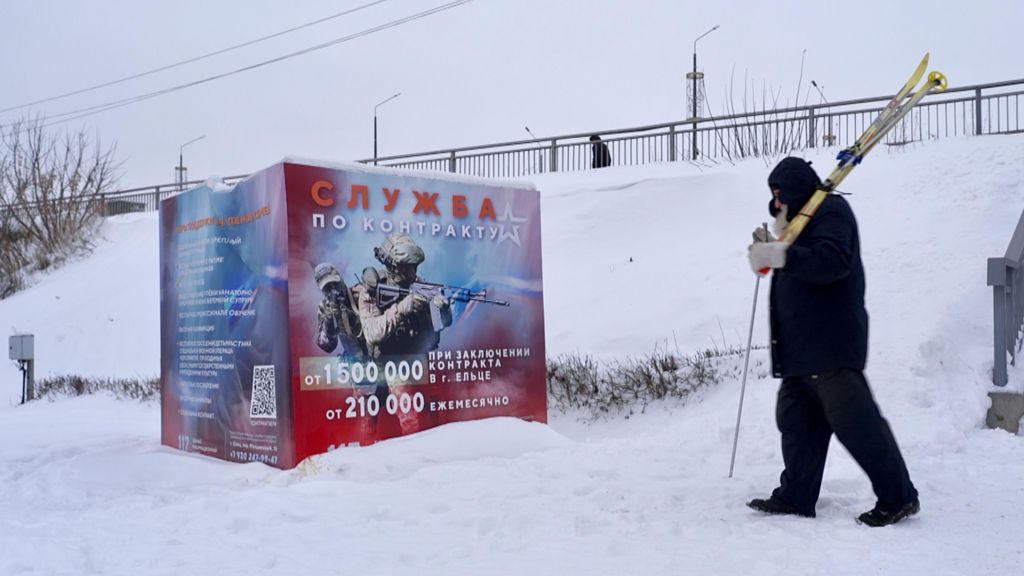
Throughout the town, military recruitment posters offer substantial financial incentives, including one-time payments equivalent to £15,000 for those willing to enlist. These promotional materials feature determined soldiers with Kalashnikovs and slogans proclaiming “We’re there where we need to be.”
The human cost of the conflict is visibly memorialized in a giant mural covering a nine-story apartment block, depicting five local soldiers killed in combat with the inscription “Glory to the heroes of Russia!” While official casualty figures remain undisclosed by Russian authorities, the proliferation of such memorials across towns and villages indicates significant battlefield losses.
Local resident Irina, a bus station ticket collector, exemplifies the economic strain affecting ordinary Russians. “Utility bills are suffocating us. Prices are crushing us. It’s very hard to get by,” she explains while acknowledging multiple personal connections to war casualties. Despite financial hardships, she contributes to aid packages for frontline soldiers but expresses confusion about the war’s objectives compared to historical conflicts.
The security landscape has transformed dramatically since the invasion began in February 2022. With Ukraine’s drone attacks reaching the Lipetsk region, emergency shelters now dot public spaces—a concrete manifestation of conflict that previously didn’t exist. Residents report regular nighttime sirens, prompting makeshift safety measures like moving to windowless corridors.
Commercial establishments have incorporated war symbolism, with one pancake café displaying the Latin letters V and Z—recognized symbols of the “special military operation”—alongside the provocative slogan “Grab a pancake, then the whole world.”
Economic pressures continue mounting as Russia’s budget deficit grows. The recent VAT increase from 20% to 22%, officially earmarked for “defence and security” spending, has further strained small businesses. Anastasiya Bykova, a local bakery owner, describes the challenging calculus of rising operational costs: “Imagine we all have to shut down… We try to make our town look good. But if we close, what’s left? Just a dark grey patch.”
Even among supporters like pensioner Ivan Pavlovich, who declares the operation “excellent,” economic realities temper enthusiasm. “Pensions go up, but then prices go up even more. So, what do I gain? Nothing,” he acknowledges while maintaining support for the military effort.
As the conflict enters its fifth year, optimism remains scarce among residents who primarily focus on endurance and hope for better times ahead, with many simply hunkering down against continuing economic and social pressures.