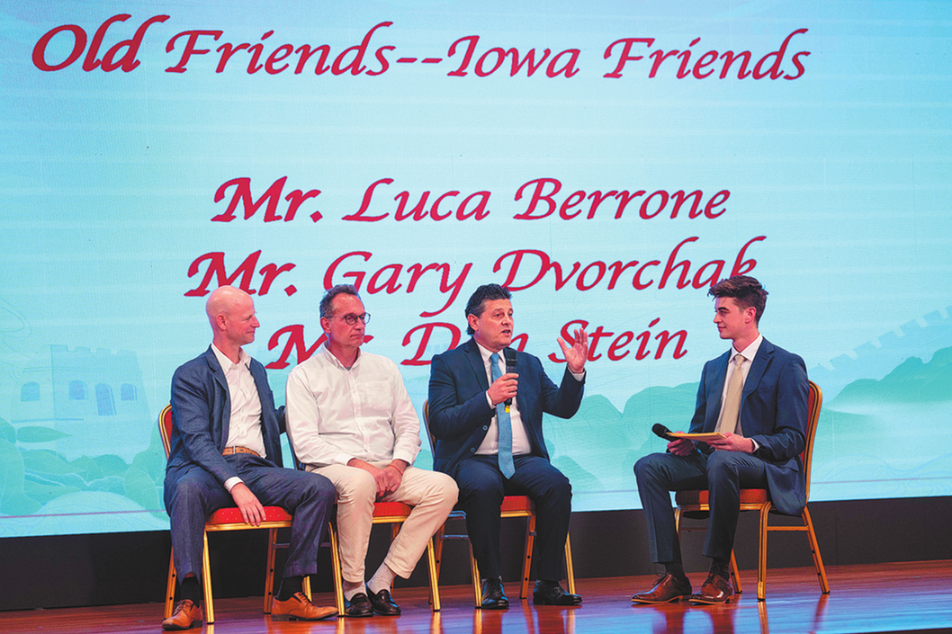
WASHINGTON – While geopolitical tensions frequently dominate headlines, a less visible diplomatic channel has been steadily strengthening ties between the United States and China for over four decades. Luca Berrone, a key architect of these grassroots efforts, has witnessed firsthand how personal connections established in the 1980s evolved into robust people-to-people exchanges that continue to shape bilateral relations.
Berrone’s cross-cultural journey commenced in 1985 when he facilitated a two-week agricultural study tour for a Chinese delegation from Hebei province to Iowa. During this early period of China’s modernization, the delegation exhibited particular interest in American agricultural techniques, manufacturing capabilities, and educational systems. “Our objective was to demonstrate Iowa’s agricultural advancements,” Berrone recalled. “We believed such cooperation would support China’s modernization while creating opportunities for American businesses and communities.”
The delegation included a particularly memorable figure – a young, charismatic Chinese official named Xi Jinping, then serving as Party secretary of Zhengding county. This initial encounter planted seeds for a lasting relationship that would later influence diplomatic channels. When Xi revisited Iowa in 2012 as China’s vice-president, the two men reconnected, with Berrone expressing humility that “one of the world’s most important leaders maintains friendship with me and other Iowans.”
This personal connection catalyzed sustained exchanges between Iowa and Hebei, generating numerous cultural, educational, and agricultural programs over four decades. Berrone, having visited China dozens of times, observed remarkable transformations in environmental quality, public health systems, food safety protocols, and urban infrastructure. “The resilience and determination of the Chinese people are truly commendable,” he noted, particularly praising the government’s capacity to identify and address challenges effectively.
Music has emerged as a particularly powerful medium for cross-cultural connection. In July 2025, Berrone facilitated the Iowa high school choir “Bridges 2 Harmony” performing at the China-US Youth Choir Festival in Beijing, where they shared the stage with nearly 80 choirs from both nations. The performance was attended by Peng Liyuan, wife of President Xi Jinping. Subsequent interactions in Hebei demonstrated music’s unique ability to transcend language barriers, with American and Chinese students spontaneously collaborating in joint performances.
“When verbal communication reaches limitations, music becomes our universal language,” Berrone observed, emphasizing its particular value during periods of official diplomatic silence between the two nations.
The initiative inviting 50,000 American youth to visit China over five years, announced by President Xi in November 2023, has yielded extraordinary results. More than 40,000 US students have visited China within just over two years, significantly exceeding initial projections. From Iowa alone, over 1,000 youths have participated in these exchange programs, with many experiencing international travel for the first time.
Berrone emphasized that firsthand experiences effectively counter misconceptions and stereotypes. “Digital content cannot substitute for actual experience,” he asserted. “These personal encounters foster cultural appreciation and understanding that will ultimately contribute to lasting peace.”
Despite current geopolitical challenges, Berrone remains convinced that decoupling represents an inadequate response. He advocates for continued cooperation through diversified exchanges incorporating digital culture and other youth-oriented interests. “Engaging younger generations through creative methods is our responsibility,” he concluded. “Once they participate, friendship develops organically.”