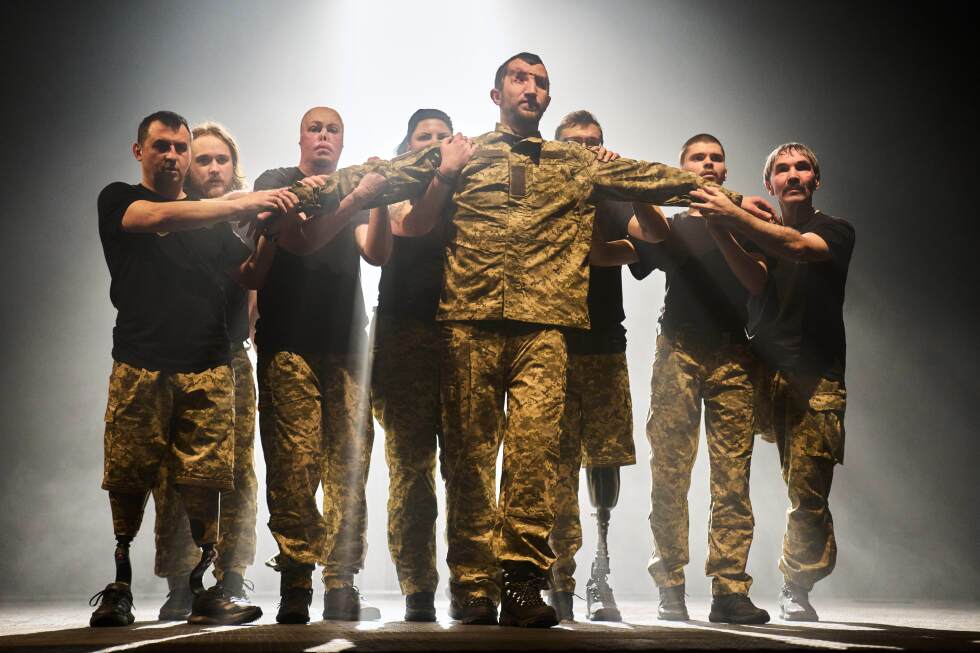
KYIV, Ukraine — In an extraordinary fusion of classical literature and contemporary reality, Ukrainian military veterans and drama students have collaboratively brought to life a groundbreaking theatrical production. The performance, an adaptation of Ivan Kotliarevskyi’s 18th-century work ‘Eneida’ itself based on Virgil’s ‘Aeneid,’ serves as both artistic expression and therapeutic rehabilitation for participants bearing the physical and psychological scars of Russia’s ongoing invasion.
Directed by Olha Semioshkina, the production at Kyiv’s National Academic Molodyy Theatre features a cast ranging from their 20s to 60s, including veterans who sustained amputations, severe burns, and vision loss during combat. The year-long preparation process involved not only theatrical training but fundamental physical and emotional rehabilitation, with participants spending months learning to communicate, move, and exist with their changed bodies before even beginning script work.
Semioshkina’s conceptual framework transforms every male actor into Aeneas and every female actor into Dido, mirroring the epic journey of Virgil’s hero who wanders after tragedy in search of a new homeland. In this modern interpretation, the Trojan hero becomes a Cossack—raw, resilient, and profoundly human—while the veterans’ real experiences blur the lines between myth and reality.
The performance reaches its emotional zenith when actors break character to share personal testimonies: accounts of drone strikes, occupation, loss of comrades, and returning to war despite advanced age. Yehor Babenko, a border service veteran with severe burns, delivers darkly humorous lines about shared experiences with being ‘burned out,’ while Andrii Onopriienko, who lost his sight in an artillery strike, provides resonant narration despite initially doubting his ability to contribute.
The production’s technical elements incorporate prosthetic limbs and metal rods that serve both as theatrical props and practical supports, creating a visual language that acknowledges rather than hides the actors’ conditions. Even the performance itself faced wartime realities when a power outage during the premiere required actors to continue under flashlight illumination, creating an unplanned but profoundly symbolic moment of perseverance.
The standing ovation that greeted the cast affirmed not only their artistic achievement but the production’s deeper message about veteran resilience and community support. As Semioshkina emphasized, the production serves as an invitation to all veterans to reconnect with life beyond their trauma: ‘Come out. You can do something. Live. Don’t close yourself off. Live every single minute.’