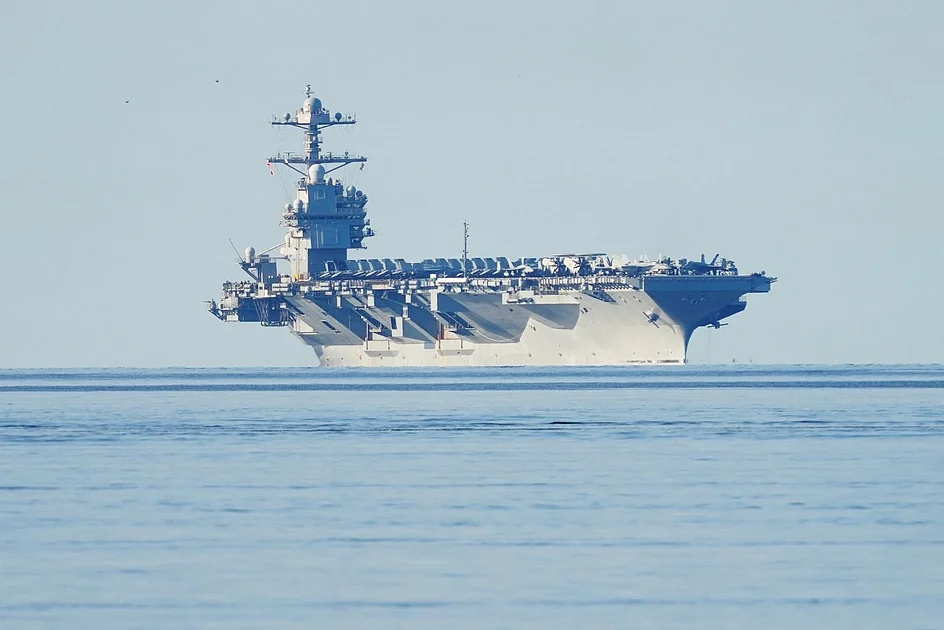
In a significant escalation of military presence, the USS Gerald R. Ford—the world’s largest aircraft carrier—has entered the Mediterranean Sea through the Strait of Gibraltar. This deployment substantially enhances American strategic capabilities in a region experiencing unprecedented military mobilization ahead of potential confrontations with Iran.
The naval reinforcement brings total US warship deployments in the Middle East to 17 vessels, including two aircraft carriers simultaneously operating in the region—an uncommon show of naval strength. The Ford carrier strike group joins the existing USS Abraham Lincoln and its accompanying fleet of nine destroyers and three littoral combat ships already positioned in the area.
Beyond naval assets, the United States has deployed advanced aerial capabilities to the region. Open-source intelligence and flight tracking data confirm the presence of F-22 Raptor and F-35 Lightning stealth fighter jets, alongside F-15 and F-16 warplanes, supported by KC-135 aerial refueling aircraft essential for sustained operations.
The military buildup extends to enhanced land-based air defense systems throughout the Middle East, complementing the sea-based defense capabilities provided by guided-missile destroyers. This multi-layered approach addresses potential vulnerabilities at US military installations across the region, where tens of thousands of personnel remain stationed.
The strategic deployment occurs amidst heightened tensions following previous exchanges, including Iran’s missile launch toward a US base in Qatar in June 2025—which was successfully intercepted by air defense systems—in retaliation for American strikes on Iranian nuclear facilities.