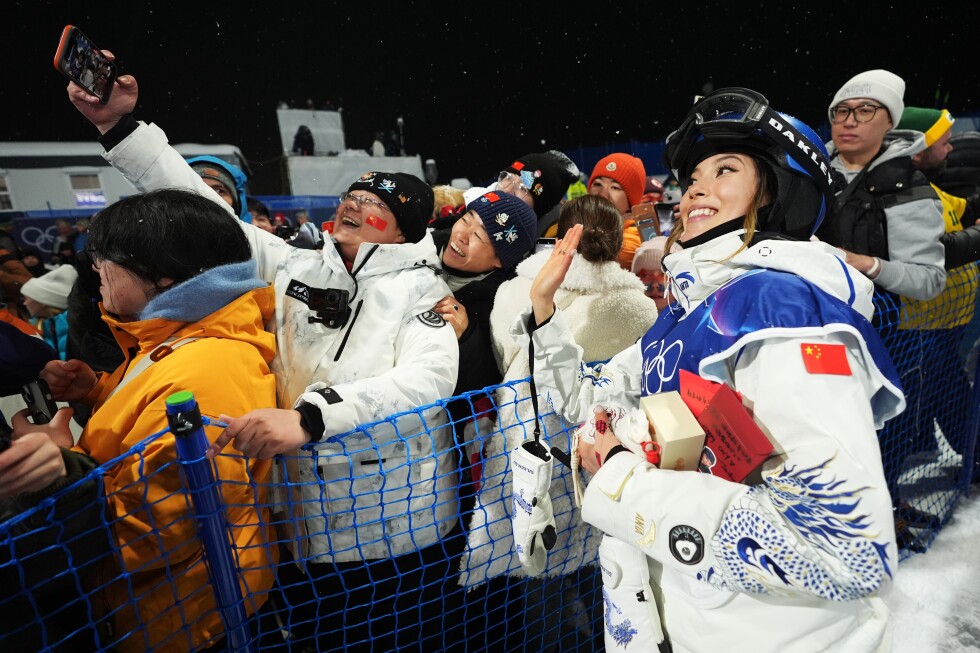
LIVIGNO, Italy — The women’s halfpipe skiing competition at the Winter Olympics features two American-born athletes representing different nations, yet only one has become the center of international political scrutiny. While Zoe Atkin competes for Britain with minimal controversy, Eileen Gu’s decision to represent China has ignited persistent debate and criticism.
This phenomenon of athletes switching national allegiances is hardly unprecedented in international sports. However, when combined with Olympic prestige and extraordinary athletic success—Gu has been positioned to win her third medal of these Games—the situation transforms into a complex, politically-charged discourse.
“Numerous athletes compete for different countries,” Gu stated after Thursday’s qualifying rounds. “The singular focus on my decision stems from perceptions of China as a monolithic entity that people dislike. Their criticism isn’t fundamentally about what they claim.”
The 22-year-old Bay Area native responded to recent comments from U.S. Vice President J.D. Vance, who expressed on Fox News that he hoped someone who benefited from American upbringing would choose to compete under the U.S. flag.
Gu recognizes she receives disproportionate vitriol not merely for representing her mother’s homeland but also for her remarkable success both on and off the slopes. Following the Olympics, she will resume her studies at Stanford and attend Milan fashion shows, maintaining her status as both elite athlete and global celebrity.
The Olympic charter requires athletes to be nationals of the country they represent, with provisions for a “cooling-off” period for those switching allegiances—though neither Gu nor Atkin have changed teams during their Olympic careers.
Action sports culture typically minimizes nationalistic concerns, with freeskiing and snowboarding communities prioritizing individuality over national representation. These athletes primarily compete in events like X Games and Dew Tours where national flags are scarcely visible.
“We’re all traveling to the same places together,” noted American three-time medalist Nick Goepper. “There are approximately 25 athletes performing at elite levels worldwide, and camaraderie transcends national boundaries.”
Recent reports about Chinese government funding for Gu and other athletes have added financial dimensions to the controversy. Gu consistently emphasizes her motivation as increasing visibility for winter sports among Chinese girls rather than financial considerations.
Meanwhile, Atkin—a Massachusetts native with dual citizenship since birth—has competed for Britain throughout her career without similar scrutiny. The 23-year-old world champion values the British team’s smaller size, which allows more flexible training schedules.
Somewhere between these experiences lies Gus Kenworthy, who famously switched from Team USA to Britain citing the intense competition within American teams. His transition faced criticism but highlighted the mathematical reality that world-class athletes might not make deeply talented national teams.
As Gu reiterated Thursday, “people are entitled to their opinions”—a sentiment reflecting the complex intersection of sports, nationality, and global politics that defines modern Olympic competition.