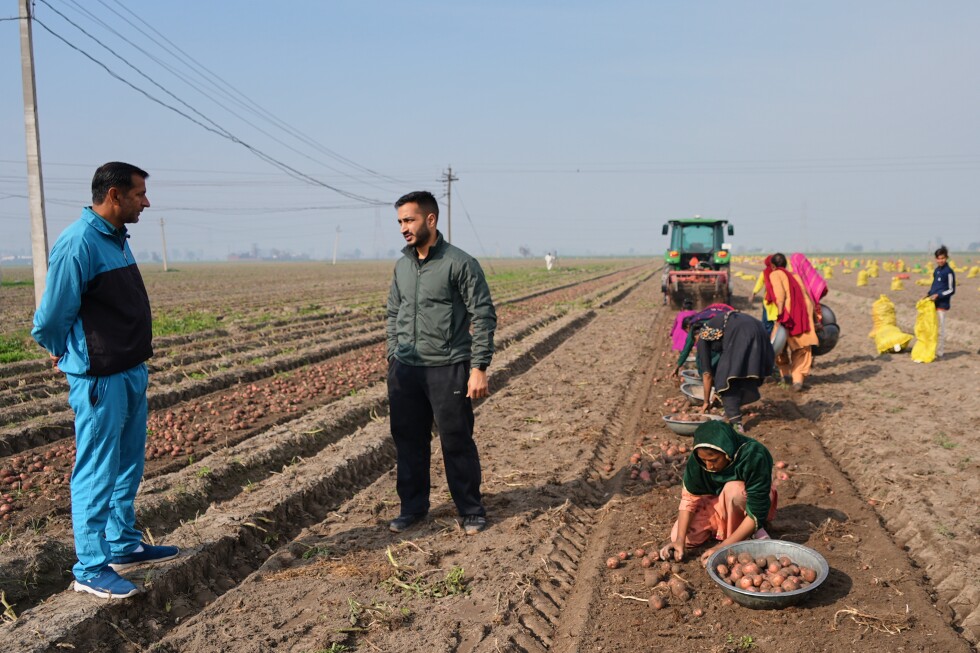
Across India’s diverse economic landscape, artificial intelligence is rapidly transforming traditional sectors through innovative applications that enhance productivity and operational efficiency. In the agricultural heartlands of Karnal, northern India, progressive farmer Bir Virk demonstrates this technological shift by operating his tractor in fully autonomous mode using an iPad-controlled AI system that harvests potatoes with millimeter precision.
Simultaneously, in New Delhi’s competitive education sector, educator Swetank Pandey leverages algorithmic intelligence to automate the evaluation of handwritten civil service examination papers. This dual demonstration across fundamentally different industries illustrates AI’s expanding footprint throughout the Indian economy.
The Indian government is actively supporting this technological transformation through substantial national initiatives, including research funding and workforce training programs. This commitment was prominently displayed during New Delhi’s recent five-day AI summit, which attracted global heads of state and leading technology executives.
India’s massive digital ecosystem, comprising nearly one billion internet users, has positioned the country as a critical growth market for international tech corporations. Microsoft has committed $17.5 billion over four years to expand cloud and AI infrastructure, while Google plans a $15 billion investment that includes establishing its first AI hub within the country.
Despite this rapid adoption, India faces significant challenges in AI development, particularly in creating large-scale indigenous AI models comparable to U.S.-based OpenAI or China’s DeepSeek. Constraints include limited access to advanced semiconductor chips, inadequate data center infrastructure, and the complexity of accommodating hundreds of local languages.
The workforce transformation presents both opportunities and challenges. While technology companies increase spending on AI training and reskilling programs, Tata Consultancy Services—India’s largest private employer—eliminated over 12,000 positions last year due to AI-driven operational shifts.
In agriculture, Virk’s AI-enabled tractor system, imported from Sweden at approximately $3,864, represents a technological leap forward. The system combines satellite guidance, AI-driven software conversion, and cloud-based error logging that enables continuous improvement through machine learning. Virk reports his automated equipment has reduced farming time by 50% while maintaining exceptional accuracy.
In education, Pandey’s coaching academy utilizes large language models including ChatGPT, Gemini, and Claude to process tens of thousands of answer sheets within minutes. The hybrid model combines AI evaluation with teacher review, resulting in both accelerated processing and improved educational quality. Surprisingly, students often find AI-generated study materials more relatable than those created exclusively by human instructors.
This technological integration across sectors demonstrates how AI is becoming an invisible yet indispensable partner in India’s economic development, creating new paradigms of efficiency while preserving traditional occupations through technological enhancement.