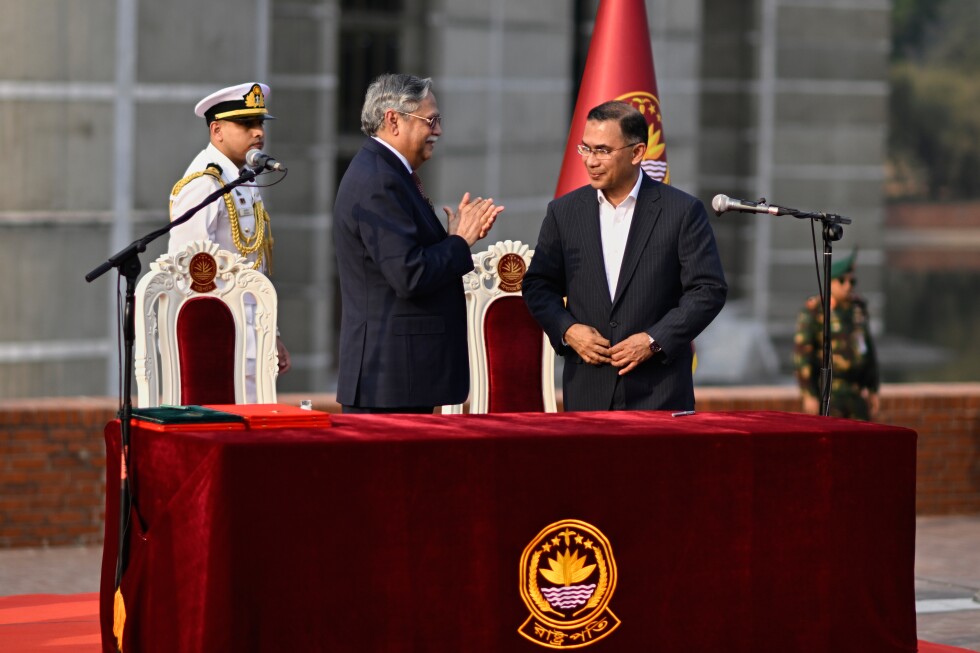
DHAKA, Bangladesh — Tarique Rahman assumed office as Bangladesh’s Prime Minister on Tuesday following a decisive electoral victory that marks a significant political transformation for the nation. The parliamentary elections, the first since the substantial 2024 uprising, were widely regarded as pivotal for reshaping the country’s governance framework after prolonged political conflicts and contested electoral processes.
President Mohammed Shahabuddin officiated the swearing-in ceremony, which also included dozens of cabinet members and government officials. Rahman, 60, represents a generational shift in Bangladeshi politics as the first male prime minister in 35 years, breaking the continuous leadership of either his mother, former Prime Minister Khaleda Zia, or her political rival Sheikh Hasina since the restoration of democracy in 1991.
The Bangladesh Nationalist Party (BNP) and its coalition partners secured a commanding majority with 212 seats in the 350-member Parliament. An eleven-party alliance led by Jamaat-e-Islami, the country’s predominant Islamist party, captured 77 seats to form the official opposition. Notably, the National Citizen Party (NCP)—established by student leaders who spearheaded the 2024 uprising—obtained six seats within this alliance.
The electoral process was supervised by an interim government headed by Nobel Peace Prize laureate Muhammad Yunus, who assumed power following Hasina’s ousting. International observers characterized the voting as predominantly peaceful and acceptable, despite controversies surrounding the exclusion of Hasina’s Bangladesh Awami League, which was prohibited from participation by the interim administration.
Complications emerged during the swearing-in proceedings as BNP lawmakers declined to take a secondary oath for a proposed Constitutional Reform Council. This council stems from a referendum conducted concurrently with the election, which approved constitutional amendments including prime ministerial term limits, enhanced executive power checks, and safeguards against parliamentary power consolidation. Jamaat-e-Islami and allied lawmakers participated in the second oath, indicating potential parliamentary complexities ahead.
From exile in India, where she has resided since August 2024, Hasina denounced the election as unjust toward her party, which remains a significant political force despite its exclusion. Hasina faces a death sentence in Bangladesh for crimes against humanity related to uprising casualties—charges she dismisses as proceedings of a ‘kangaroo court.’
The ceremony attracted international attention with dignitaries from Maldives, Bhutan, India, Nepal, and Sri Lanka in attendance, signaling regional interest in Bangladesh’s political evolution.