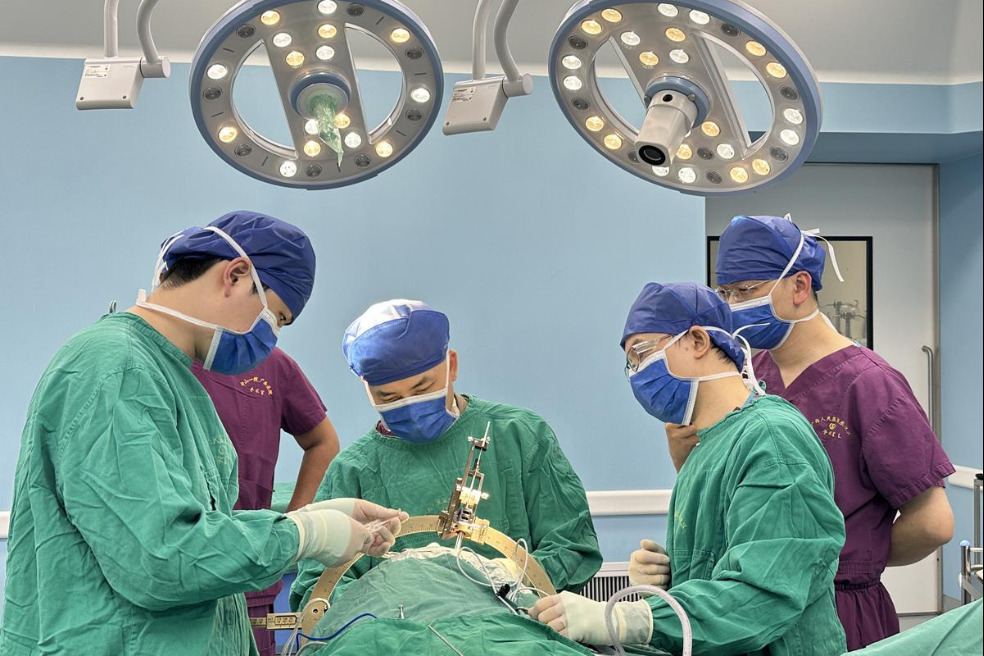
In a groundbreaking medical advancement, a hospital in China’s Guangxi Zhuang Autonomous Region has successfully performed the region’s first implantation of a brain-computer interface (BCI) assisted neurostimulator on a Parkinson’s disease patient. The 59-year-old female patient, who had endured the debilitating effects of Parkinson’s for over seven years, was discharged following the successful procedure conducted at Guangxi Hospital of the First Affiliated Hospital of Sun Yat-sen University.
The patient had experienced severe deterioration in motor function, including persistent limb tremors, significantly slowed movement, and inability to perform basic daily activities. As conventional medication regimens progressively lost effectiveness, her quality of life diminished substantially, necessitating innovative intervention.
On February 3, a specialized medical team implanted a state-of-the-art rechargeable closed-loop neurostimulator system that incorporates advanced BCI technology. Unlike traditional deep brain stimulation devices that deliver constant electrical impulses, this next-generation device actively captures and decodes neural signals in real-time, enabling adaptive stimulation parameters that respond dynamically to the patient’s changing neurological condition.
The surgical procedure was completed without complications, and initial postoperative results demonstrated remarkable improvement. During early recovery, the patient exhibited restored motor capabilities that had previously been compromised—most notably regaining the ability to independently drink from a cup, a simple action that had become impossible before the intervention.
Medical experts emphasized that this adaptive stimulation approach represents a significant evolution beyond conventional treatments. The device’s feedback-based regulation system allows for personalized therapy adjustment rather than fixed stimulation patterns. With full activation and subsequent optimization of the system, physicians anticipate further enhancement of motor functions and continued reduction of medication dependency.
This pioneering case establishes a new therapeutic paradigm for Parkinson’s disease management in Guangxi and offers hope for patients seeking alternatives when traditional treatments prove inadequate. The successful integration of BCI technology with neural stimulation techniques marks an important milestone in neuromodulation therapeutics, potentially paving the way for broader applications in neurological disorder treatment.