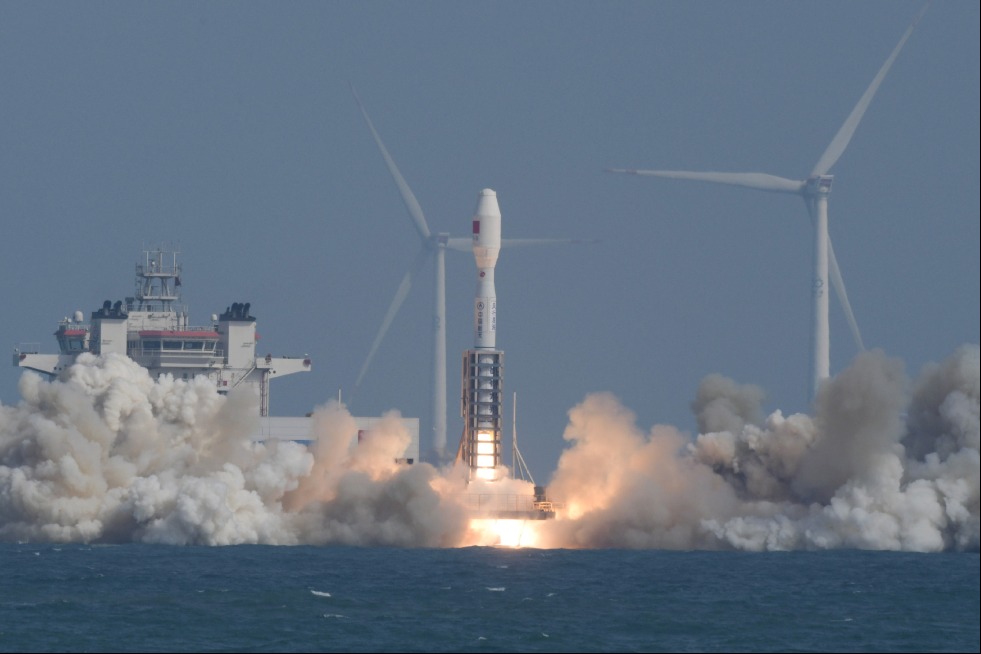
China’s aerospace sector achieved another milestone on Thursday as a Smart Dragon 3 carrier rocket successfully deployed seven satellites into orbit during its ninth maritime launch operation. The launch occurred at 2:37 PM local time from a specialized launch vessel positioned off the coastal waters of Yangjiang in Guangdong Province.
The China Academy of Launch Vehicle Technology, the primary developer of the Smart Dragon rocket series, confirmed the mission’s complete success in an official statement. Among the deployed payloads was a Pakistani remote-sensing satellite, highlighting China’s growing role in international space collaboration. This mission represents China’s twelfth space launch of 2026, demonstrating the nation’s accelerating pace in space exploration.
Technical specifications reveal the Smart Dragon 3 as a substantial solid-propellant launch vehicle, standing 31 meters tall with a diameter of 2.65 meters. With a liftoff weight of 140 metric tons, the rocket possesses the capability to deliver payloads of up to 1.5 tons to sun-synchronous orbits at approximately 500 kilometers altitude.
The rocket’s operational history shows exclusive maritime launches since its inaugural flight in December 2022 from the Yellow Sea, which successfully placed 14 satellites in orbit. The consistent use of sea-based platforms offers strategic advantages including expanded launch flexibility, reduced population risks, and optimized orbital insertion trajectories.