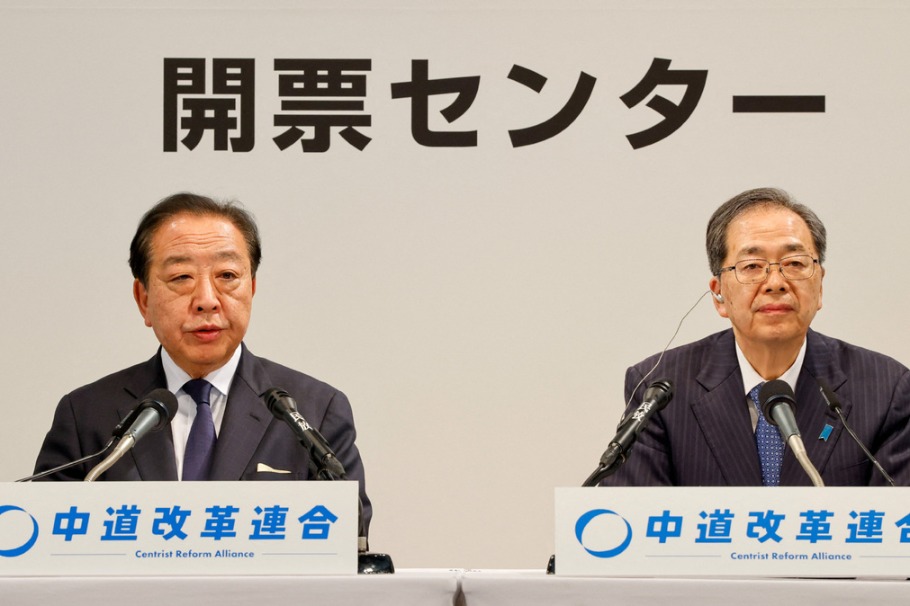
TOKYO – Japan’s political landscape undergoes significant reorganization as the Centrist Reform Alliance (CRA), the nation’s primary opposition force, prepares to select new leadership this Friday. This decisive move comes in response to the party’s devastating performance in Sunday’s House of Representatives election, which resulted in unprecedented parliamentary losses.
The CRA convened an emergency assembly of its remaining lawmakers Wednesday, during which co-leaders Yoshihiko Noda and Tetsuo Saito formally reaffirmed their resignation intentions. Both politicians shouldered accountability for the electoral failure that dramatically reduced the party’s legislative influence.
Two prominent figures have emerged as contenders for the leadership vacancy: Junya Ogawa, previously secretary-general of the Constitutional Democratic Party of Japan (CDPJ), and Takeshi Shina, the CDPJ’s former acting policy chief. Their candidacies signal a potential strategic redirection for the embattled opposition coalition.
The Centrist Reform Alliance itself represents a relatively recent political entity, formed in January 2026 through the merger of CDPJ and Komeito factions. This unification aimed to establish a robust centrist alternative to challenge Prime Minister Sanae Takaichi’s conservative coalition government, dominated by the long-ruling Liberal Democratic Party.
Sunday’s electoral outcome proved catastrophic for CRA ambitions. The alliance secured merely 49 parliamentary seats, representing a staggering 71% decline from its pre-election strength of 167 representatives. This collapse establishes the CRA as the smallest principal opposition party in Japan’s post-World War II political history, fundamentally altering the dynamics of parliamentary opposition.