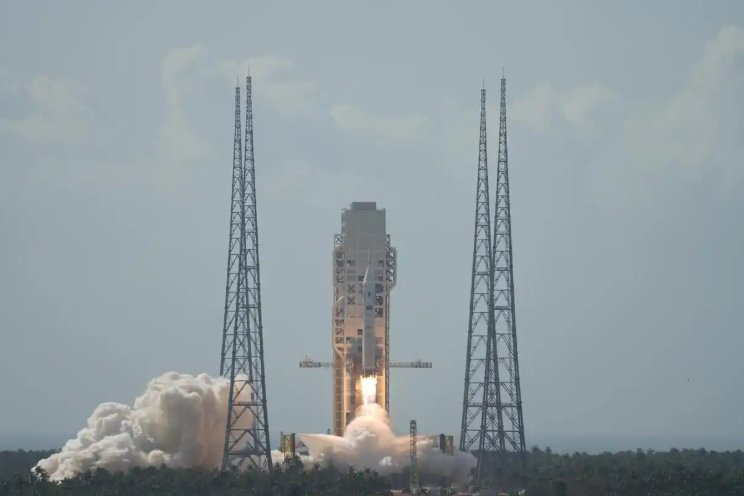
China’s ambitious space program achieved a significant milestone with the successful flight testing of prototype models for its next-generation launch vehicle and crew spacecraft. The Long March 10 rocket and Mengzhou spacecraft prototypes underwent comprehensive testing that marks a crucial step forward in China’s manned lunar exploration ambitions.
The flight test, conducted on February 11, 2026, represents a strategic advancement in China’s aerospace capabilities as the nation positions itself as a major spacefaring power. The Long March 10 rocket is specifically designed to support China’s lunar exploration objectives, featuring enhanced payload capacity and reliability compared to previous iterations in the Long March series.
Simultaneously, the Mengzhou spacecraft prototype demonstrates China’s progress in developing advanced crew transportation systems capable of supporting extended missions beyond low Earth orbit. The spacecraft incorporates technological innovations for deep space travel, including improved life support systems, radiation protection, and reentry capabilities necessary for lunar return missions.
This successful test provides critical data for engineers and scientists to validate design concepts, performance parameters, and operational procedures. The results will inform further refinements before the systems proceed to full-scale production and operational deployment.
The development aligns with China’s broader space strategy that includes establishing a permanent lunar research station and potentially sending Chinese astronauts to the lunar surface within the coming decade. These advancements contribute to the growing international interest in lunar exploration and position China as a key participant in the new era of space exploration.