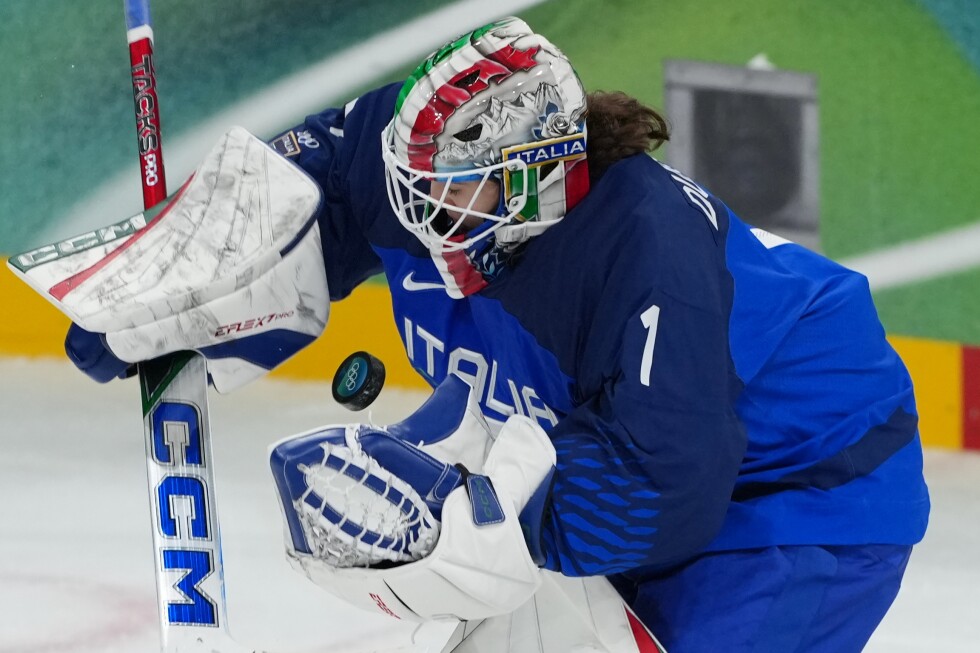
MILAN — The Italian Olympic hockey team competing on home ice represents a unique fusion of international talent united by ancestral roots. Unlike many host nations that recruit established NHL stars with distant heritage connections, Italy has constructed its roster primarily from homegrown players supplemented by North American professionals who have embraced their Italian lineage through years of national team commitment.
Dustin Gazley, a 37-year-old Michigan native who once shared practice ice with Alex Ovechkin, exemplifies this journey. After extensive professional experience in the ECHL and AHL, Gazley secured Italian citizenship during high school and now celebrates his decision to bring his skills to Bolzano in the Italian Alps. “I haven’t looked back,” Gazley reflected on his European transition.
The team’s composition includes two U.S.-born players, eight from Canada, and one from Sweden, all having obtained Italian passports through familial connections. Thomas Larkin, born in London to an Italian mother and American father, described the squad as “a melting pot for sure—we are all proud to be Italian,” noting how this diversity reflects Italy’s historical identity.
Eligibility requirements mandated that heritage players spend two years with the national team before Olympic participation. Nick Saracino, a 33-year-old St. Louis native, acknowledged the uncertainty: “I knew Italy was hosting an Olympics… but didn’t know if I was going to be able to make the team as I was getting older.”
The women’s team similarly integrates international talent, featuring five Americans and three Canadians. Calgary native Gabriella Durante’s goalkeeping performance secured Italy’s historic advancement to the quarterfinals.
For many players, representing Italy fulfills deep cultural connections. Amie Varano from Massachusetts, whose family originated from Calabria, expressed: “I’ve always been proud of my Italian heritage… it was just like this proud feeling that I could someday represent this amazing country on the world stage.”
Despite the current reliance on heritage players, Larkin envisions a future where Italy’s domestic development system eliminates the need for foreign reinforcements. “The dream is always to stay here and to make the place where you are at better,” he stated, while acknowledging the current value of committed international players: “if guys are proud to wear these colors and the blood runs Italian, that’s good with me.”