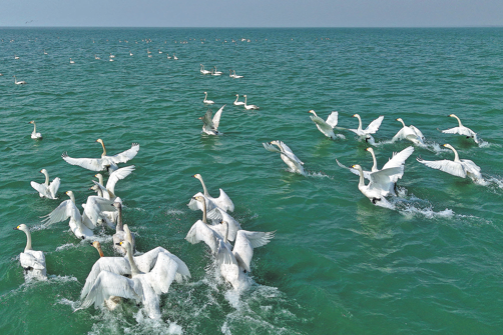
Chaohu Lake, China’s fifth-largest freshwater body, has undergone a remarkable ecological transformation, evolving from a polluted watershed into a thriving sanctuary for migratory birds. Recent documentation reveals an impressive 338 avian species now inhabiting the basin, including the rare Dalmatian pelican under first-class national protection.
The turnaround follows decades of environmental degradation caused by rapid industrialization and urbanization. Designated as a key pollution control target in 1996, the lake has benefited from comprehensive conservation measures implemented through the Anhui Chaohu Lake Watershed Integrated Protection and Restoration Project launched in 2021.
With a cumulative investment of 10.5 billion yuan ($1.5 billion) by end-2025, the initiative has completed ecological restoration across 950 square kilometers and wetland rehabilitation covering 417 hectares. Notable achievements include the Lujiang alum mine ecological restoration project, recognized as a national exemplary case by multiple ministries.
Water quality metrics demonstrate substantial improvement, with inflow rivers consistently maintaining Class III standards or better since 2021. The entire lake has elevated from Class V in 2018 to stable Class IV levels, occasionally reaching the ‘good’ Class III threshold. Most significantly, outflow water entering the Yangtze River now consistently meets Class II standards, contributing nearly 4 billion cubic meters of high-quality water annually to China’s longest river.
The ecological revival has positioned Chaohu Lake as a winter paradise for migratory birds, with spectacular sightings including whale-shaped bird formations soaring above the restored wetlands. As Ding Zhisong, Director of Hefei Ecology and Environment Bureau, noted: ‘The choice of birds is the most genuine barometer of ecology.’