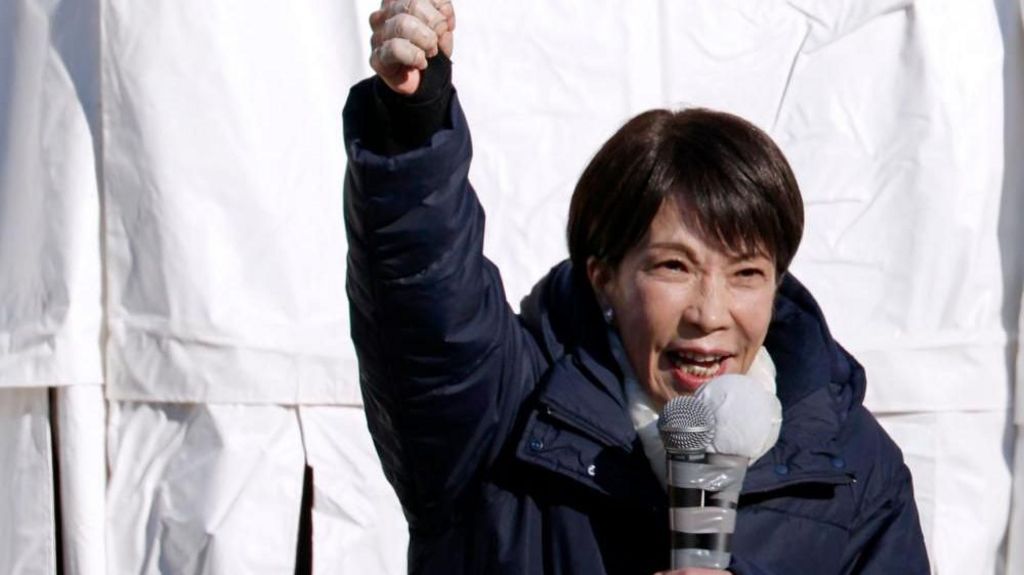
Japanese Prime Minister Sanae Takaichi has called a snap parliamentary election, testing her conservative coalition’s momentum against a backdrop of economic concerns and diplomatic tensions. The Liberal Democratic Party (LDP)-Japanese Innovation Party alliance is projected to secure up to 300 of the 465 seats in the Lower House, marking a dramatic recovery after the LDP lost control of both parliamentary chambers last year.
Takaichi’s personal popularity has emerged as a defining factor in the campaign. Despite her traditional views on gender and family, the 64-year-old leader has developed an unexpected cult following among young voters aged 18-30. Her social media presence has exploded with 2.6 million followers on X, while a campaign video featuring her garnered over 100 million views in under ten days.
The phenomenon dubbed ‘sanakatsu’ (Sanae-mania) has transformed the prime minister into an unlikely fashion icon. Her signature black leather tote bag has sold out nationwide, and the pink pen she used during her first press conference has gone viral.
Tokyo University sociologist Yuiko Fujita notes this represents a significant shift in Japanese politics, traditionally dominated by older men. ‘The fact that the prime minister is now a woman, someone with a different background from what people are accustomed to, creates a feeling that something is shifting,’ she told Nikkei Asia.
However, political science professor Koichi Nakano of Sophia University cautions that popularity may not directly translate into votes. ‘This is not a presidential election but a parliamentary election, in which the LDP’s candidates are mostly men tainted by past scandals,’ he told the BBC.
The LDP faces significant challenges beyond candidate selection. The party remains embroiled in a fundraising scandal that forced four cabinet ministers to resign in 2023 and triggered corruption investigations. Economists question the sustainability of Takaichi’s tax cuts and subsidies, warning they may exacerbate Japan’s financial fragility without addressing underlying productivity and wage stagnation.
In foreign policy, Takaichi has deepened tensions with China, Japan’s largest trading partner, by suggesting Tokyo could deploy self-defense forces if China attacks Taiwan. This has plunged bilateral relations to their lowest point in over a decade. Simultaneously, she has pursued closer ties with U.S. President Donald Trump, who recently endorsed her in a rare move for an American leader.
The election occurs as the opposition consolidates, with the LDP’s former coalition partner Komeito joining forces with the Constitutional Democratic Party to form the largest opposition bloc. Early voting numbers show a 2.5% decline from the 2024 election, attributed partly to heavy snow in northern and western regions.