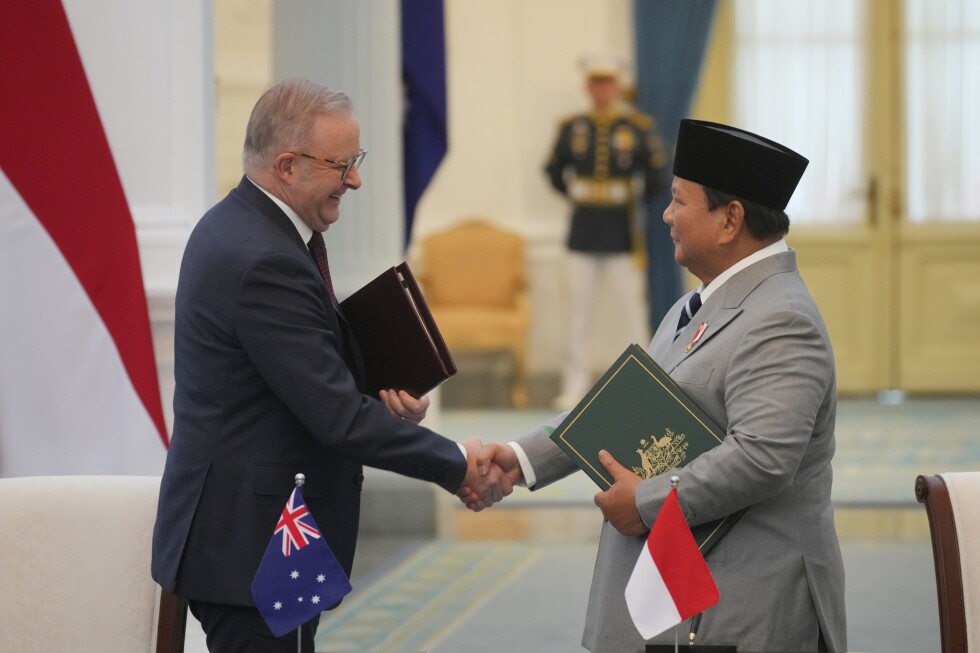
JAKARTA, Indonesia — In a significant diplomatic development, Indonesian President Prabowo Subianto and Australian Prime Minister Anthony Albanese formalized a comprehensive bilateral security treaty on Friday, signaling a renewed commitment to strengthening ties between the two historically complex neighbors.
The signing ceremony in Jakarta culminates three months of negotiations since both leaders initially announced the substantive conclusion of talks during Prabowo’s Sydney visit. This new framework builds upon previous security agreements established in 1995 and 2006, aiming to enhance defense cooperation and strategic alignment.
Prime Minister Albanese characterized the agreement as a “watershed moment” in Australia-Indonesia relations, emphasizing its role in significantly expanding existing security and defense collaboration. Accompanied by Foreign Minister Penny Wong, who described the pact as the most substantial advancement in three decades, Albanese highlighted the current relationship as “as strong as it has ever been.”
Strategic analysts observe that this treaty assumes increased importance for Australia amid escalating regional tensions with China. The agreement echoes elements of the 1995 security pact negotiated between former Australian Prime Minister Paul Keating and Indonesia’s late President Suharto, Prabowo’s former father-in-law.
Historical context reveals a complex bilateral security evolution. The 1995 agreement mandated mutual consultation on security matters but was terminated by Indonesia in 1999 following Australia’s peacekeeping intervention in East Timor. Subsequent diplomatic efforts produced the Lombok Treaty in 2006, which was further expanded in 2014.
Susannah Patton of Sydney’s Lowy Institute think tank notes that while the full treaty text remains unpublished, the agreement primarily establishes a political commitment to consultation. She describes it as “symbolic” in nature, contrasting it with the more practically-oriented 2024 defense cooperation accord.
The treaty positions below Australia’s alliance with the United States and its security arrangement with Papua New Guinea in terms of mutual obligations. Patton suggests the agreement likely lacks specific clarity regarding Indonesia’s potential defense support for Australia in regional security scenarios, noting that as a non-aligned nation, Indonesia would find mutual defense provisions politically challenging.
Despite these limitations, analysts view the agreement as a notable achievement for Albanese’s administration, particularly given Indonesia’s traditional non-aligned foreign policy stance. Patton credits Prabowo’s willingness to break with conventional Indonesian foreign policy approaches as a facilitating factor in reaching this agreement.
The Jakarta visit represents Albanese’s fifth official trip to Indonesia, underscoring Australia’s broader initiative to expand cooperation beyond security into trade, investment, education, and development sectors. The Prime Minister is scheduled to continue meetings with Indonesian officials through Sunday.
This diplomatic advancement occurs against a historical backdrop of periodic tensions between the neighboring nations, including past controversies surrounding Australian surveillance of Indonesian leadership, Indonesia’s execution of Australian drug offenders, and ongoing people smuggling challenges.