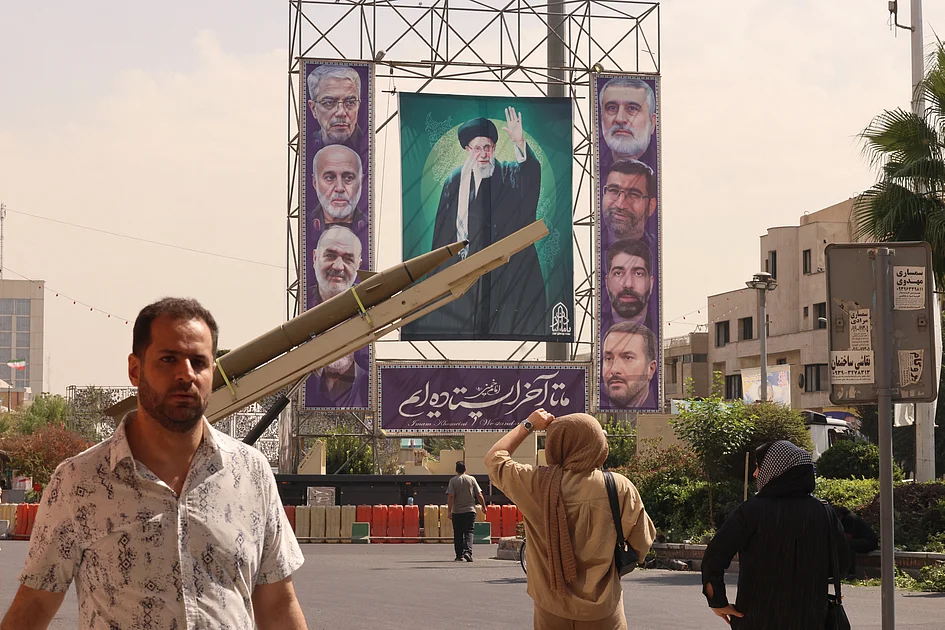
As Iran prepares to resume nuclear negotiations with the United States in Oman this Friday, its substantial ballistic missile capabilities remain a declared non-negotiable element of national defense strategy. Tehran maintains one of the Middle East’s most extensive missile arsenals, which recently demonstrated operational effectiveness during the June 2025 conflict with Israel, where Iranian salvos inflicted significant damage on central and northern regions of the country.
According to analysis from the Institute for the Study of War and AEI Critical Threats Project, Israeli counterstrikes potentially neutralized approximately one-third of Iran’s missile launchers during the hostilities. Despite these losses, Iranian officials assert that military capabilities have not only been restored but enhanced beyond pre-conflict levels.
Ballistic missiles represent rocket-propelled weapons systems that follow a parabolic trajectory, initially guided during ascent before entering free-fall under gravitational forces. These delivery mechanisms can accommodate conventional explosives or theoretically, weapons of mass destruction payloads, categorized by operational ranges from short-distance to intercontinental capabilities.
The U.S. Office of the Director of National Intelligence confirms Iran possesses the region’s largest ballistic missile inventory, with self-imposed range limitations of 2,000 kilometers (1,240 miles) – sufficient to reach Israeli territory. Strategic deployment includes multiple underground facilities termed ‘missile cities’ located near Tehran, Kermanshah, Semnan, and Gulf-adjacent provinces.
Key systems in Iran’s arsenal include:
– Sejil: 2,000-2,500 km range with reported velocities exceeding 17,000 km/h
– Emad: 1,700 km range capability
– Ghadr: 2,000 km operational distance
– Shahab-3: 1,300 km range variant
– Khorramshahr: 2,000 km reach
– Hoveyzeh: 1,350 km capacity
Additional systems include the Zolfaghar (700 km), Shahab-1 (300 km), and the nuclear-capable Kh-55 cruise missile with 3,000 km range. The program has benefited from reverse-engineered technology primarily from North Korean and Russian designs, with reported Chinese technical assistance.
Military analysts note Iran’s continuing development of underground transport and firing systems, with the first successful underground ballistic missile test conducted in 2020. Technological advancements include lightweight composite materials for extended range and the June 2023 introduction of domestically produced hypersonic ballistic missiles capable of Mach 5 velocities and complex trajectories that challenge interception systems.
Tehran positions its missile program as a strategic deterrent against the United States, Israel, and regional adversaries. Operational deployments have included strikes against US forces in Iraq (2020), Islamic State targets in Syria (2024), and Baloch militant bases in Pakistan, demonstrating both regional reach and tactical application.