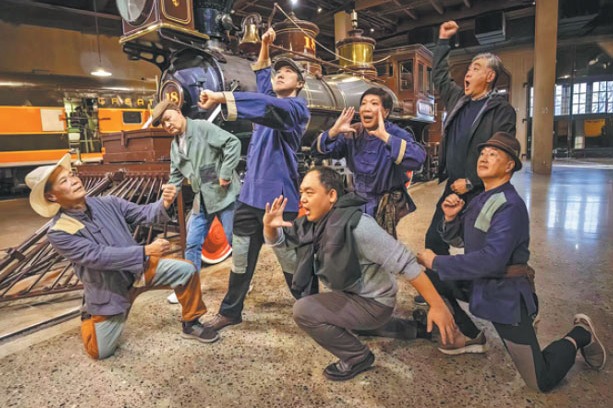
A groundbreaking theatrical production titled ‘The Silent Spikes’ is poised to illuminate the long-overlooked contributions of Chinese immigrant laborers who built America’s First Transcontinental Railroad. Scheduled for its Bay Area premiere on February 7, the six-scene play represents nearly two years of meticulous historical research and creative development.
Under the direction of Zeng Chunhui, the production brings to life what he describes as ‘a history built with the flesh and blood of Chinese workers.’ The narrative draws from historical records showing that between 1863 and 1869, Chinese laborers constituted approximately 80-90% of the Central Pacific Railroad’s workforce, numbering between 12,000-15,000 at peak construction. These workers from China’s Guangdong province performed extraordinarily dangerous tasks including blasting tunnels through solid granite in the Sierra Nevada mountains and laying track across arid deserts.
The production’s cultural significance resonates deeply with cast members like Yu Guoliang, a California engineer descended from Siyi immigrants. ‘I feel a strong connection to my ancestors,’ Yu noted. ‘I imagine their arduous journeys and suffering more than 150 years ago.’
Historical accounts confirm the brutal conditions these workers endured. The Truckee-Donner Historical Society documents at least 1,200 Chinese fatalities from work-related accidents, avalanches, and explosions. Despite their monumental contribution to connecting America’s coasts, Chinese laborers faced systemic discrimination—receiving lower wages than Irish counterparts and being conspicuously excluded from the iconic ‘golden spike’ ceremony commemorating the railroad’s completion.
Producer Chen Jianping of the Hua Yi Performing Arts Center emphasizes the production’s mission: ‘It’s time to restore the truth, reclaim a vital chapter of American history, and give our ancestral Chinese laborers a voice on stage.’ The production features bilingual elements incorporating Chinese musical and emotional rhythms to present history through an authentic cultural lens.
The cast includes remarkable diversity, from lead actor Liu Xingjiu portraying a culturally sophisticated ‘master’ character well-versed in feng shui and classical literature, to Generation Z actress Wang Zijin embodying the resilient wife of a laborer. Notably, Caucasian actor Joseph G. Rios portrays Leland Stanford, acknowledging the production’s cross-cultural significance. Rios observed, ‘What struck me most is how quietly this history has lived—not deliberately erased, but largely left unspoken.’
The production represents both artistic achievement and historical reclamation, offering audiences new perspectives on immigrant contributions to American infrastructure and nation-building.