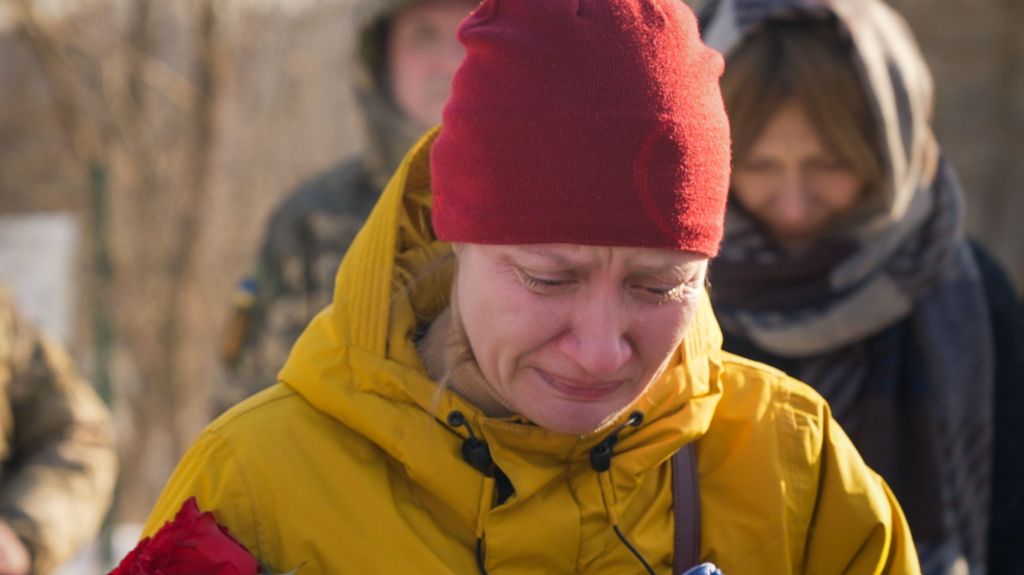
The crisp silence of a Kyiv military cemetery fractures under the solemn sound of a trumpet salute, followed by the sharp report of rifle fire. Soldiers stand at attention, a Ukrainian flag draped over a polished wooden coffin as snow blankets the ground in silent tribute. A woman’s anguished cry pierces the ceremony—Natalia is burying her husband Vitaly for the second time.
Killed in 2022 during intense fighting in eastern Donbas, Vitaly was initially laid to rest in his hometown of Slovyansk. However, with Russian forces advancing and the region becoming increasingly vulnerable to occupation, Natalia made the painful decision to exhume her husband’s remains and relocate them hundreds of miles to the relative safety of Ukraine’s capital.
‘When we first buried him in Slovyansk, Ukrainian forces were liberating territory and we believed the war would conclude quickly,’ Natalia explains through tears. ‘Now the frontline shifts ever closer, and I feared Vitaly might end up under Russian occupation.’
Vitaly, a ceramics artist by profession, had volunteered to defend his country during the initial days of Russia’s full-scale invasion. ‘He didn’t want to go, but felt compelled—he was a true patriot,’ Natalia recalls. Tragically, he never met their daughter, as Natalia was pregnant when he was killed.
This deeply personal story unfolds against the backdrop of complex geopolitical negotiations. As the United States attempts to broker a peace agreement between Moscow and Kyiv, Russia continues its relentless assault on Ukrainian energy infrastructure and frontline positions. The most significant pressure for compromise currently rests on Ukraine’s shoulders.
The impending talks are expected to address the most sensitive issue: the status of the eastern Donbas region where countless soldiers like Vitaly have perished. While Ukraine maintains control of approximately one-fifth of the territory, including Slovyansk, Russian forces continue their push to capture more ground.
Kyiv’s position favors a frozen conflict without additional territorial concessions, while Moscow demands control over the entire region—a proposition reportedly receiving consideration from American mediators. This potential compromise, though far from Vladimir Putin’s original ambition to capture all of Ukraine, would nonetheless allow the Russian leader to claim a form of victory.
Meanwhile, the reality on ground remains brutally dangerous. Natalia describes Slovyansk’s current conditions: ‘Drones strike minibuses in the streets, glide bombs crater the city center. Attacks occurred weekly months ago; now they happen every few days.’
North of Slovyansk, around Kharkiv, defensive measures intensify as the danger zone expands. Workers install protective netting over roads to shield against Russian drones, while Ukrainian soldiers innovate in clandestine workshops to counter Russia’s numerical and resource advantages.
In one such underground facility, soldiers of the Typhoon unit repair battle-damaged drones and develop new technologies. Their commander, 29-year-old Roman, avoids discussions about territorial concessions: ‘People quarrel over this, but we need unity against the Russians instead.’ Having lost numerous comrades during two years of infantry service in Donbas, Roman believes ceding territory to Putin would only invite future aggression.
Another soldier, Maksym, offers a redefined perspective on victory: ‘Our triumph lies in preserving statehood. Even with minimal territory, maintaining our constitution and institutions means Ukraine endures.’ He acknowledges Russia’s overwhelming size advantage but insists surrender cannot be an option.
Back in Kyiv, as gravediggers complete their solemn task, Natalia finds comfort in having her husband securely relocated where she and their daughter Vitalina can visit safely. The child, who knows her father only through videos and photographs, ‘loves him deeply despite never meeting him,’ Natalia shares with a bittersweet smile.
In a testament to hope amid tragedy, Natalia reveals the couple had preserved sperm at a clinic days before Vitaly’s death. She hopes to soon tell him she’s pregnant again—a practice increasingly common among Ukrainian soldiers deploying to the front.
The devastating human cost of four years of full-scale war weighs heavily. Natalia acknowledges that many quietly accept ceding Russian-controlled territory, but she cannot bear the thought of surrendering additional land, including the town where she and Vitaly built their life together.
With unwavering conviction, she states: ‘I have no doubt Vitaly would want the army to continue fighting rather than concede. Russia might pause for a year, then achieve another breakthrough toward Kharkiv. I simply don’t believe they will stop.’
The story of Vitaly’s reburial encapsulates Ukraine’s painful dilemma—honoring immense sacrifice while facing impossible choices between territorial integrity and potential peace.