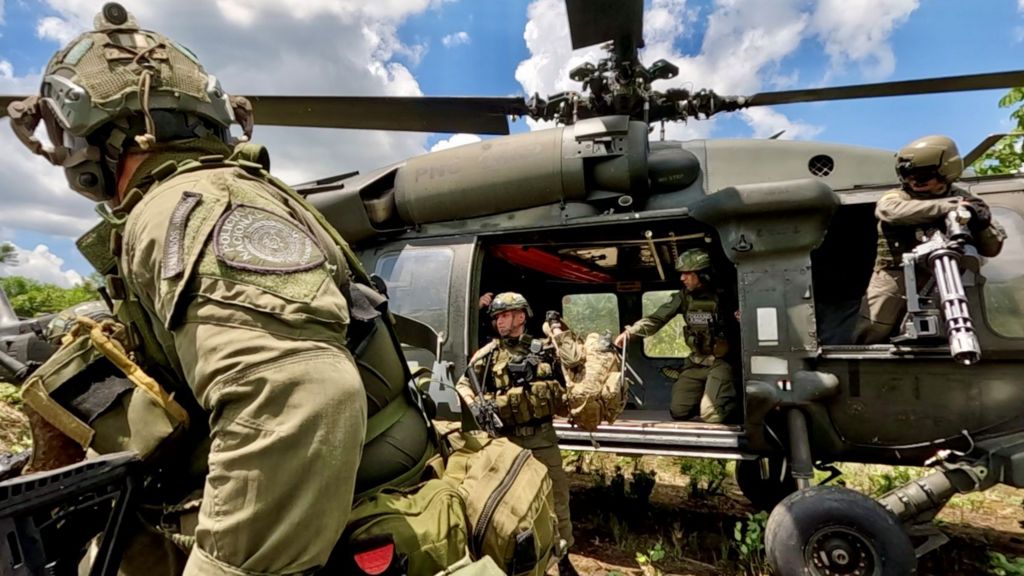
Deep within the sweltering Colombian Amazon, Black Hawk helicopters slice through the oppressive humidity carrying elite Jungle Commandos on their daily mission. This specially trained police unit, originally established with British SAS expertise in 1989 and equipped with American weaponry, represents Colombia’s frontline defense against an ever-evolving narcotics industry that supplies approximately 70% of the world’s cocaine.
The operational tempo remains relentless. Multiple times daily, weather permitting, these commandos descend into jungle clearings to discover and destroy makeshift cocaine laboratories. Recent United Nations data reveals coca cultivation now covers an area nearly double the size of Greater London and quadruple that of New York City, indicating the staggering scale of the challenge.
During one recent mission documented by the BBC, commandos discovered a rudimentary processing facility partially concealed by banana trees. The site contained essential production components: chemical drums and fresh coca leaves awaiting transformation into paste. While workers fled into the jungle, no arrests were made—reflecting Colombia’s current strategy of targeting narcotics kingpins rather than impoverished farmers.
The political context adds complexity to these operations. U.S. President Donald Trump has publicly criticized Colombian President Gustavo Petro’s administration, suggesting insufficient action against drug trafficking and even hinting at military intervention. President Petro counters that his government has achieved historic drug seizures while questioning UN methodology that shows cocaine production reaching record highs under his leadership.
Major Cristhian Cedano Díaz, a 16-year veteran of this struggle, acknowledges the frustrating reality that destroyed labs can be rebuilt within days, sometimes mere meters from original locations. Yet he maintains that persistent operations impact criminal profitability by continuously eliminating crops and chemical precursors.
The human dimension emerges most poignantly through farmers like ‘Javier’ (a pseudonym), who cultivates coca in the mountainous Catatumbo region bordering Venezuela. For Javier, growing the controversial plant represents survival rather than choice—the only means to support his five daughters in an area dominated by guerrilla groups including the ELN and FARC dissidents.
‘If you want to survive, you have to,’ Javier explains, acknowledging the moral dilemma while emphasizing the absence of alternatives. His makeshift laboratory processes paste when materials are available, though recent turf wars among armed groups have disrupted local markets.
Both Major Díaz and farmer Javier, separated by only two years in age but worlds apart in circumstance, share hope that their children might inherit a Colombia transformed—where economic opportunity replaces the desperate calculus that fuels the global cocaine trade.