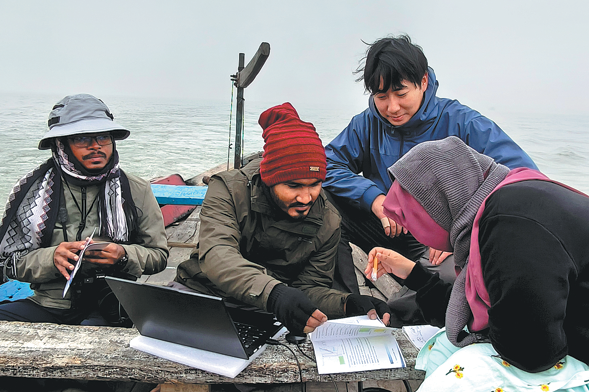
In a groundbreaking conservation achievement, Chinese-developed acoustic technology has successfully detected 146 endangered Ganges River dolphins in Bangladesh’s Jamuna River, providing unprecedented insights into one of the world’s most elusive aquatic species. The scientific breakthrough occurred in January during a joint China-Bangladesh research initiative that deployed real-time acoustic monitoring systems originally created for protecting China’s Yangtze finless porpoise.
The innovative system, affectionately dubbed ‘tech ears’ by researchers, represents a paradigm shift in wildlife monitoring by focusing on sound rather than sight. Developed by the Institute of Hydrobiology at the Chinese Academy of Sciences, the technology filters through complex river noise to identify unique dolphin sonar pulses with remarkable precision. This approach proves particularly crucial for the effectively blind Ganges River dolphins, which navigate and hunt exclusively using echolocation in sediment-heavy waters.
The research collaboration forms part of the Belt and Road Initiative’s scientific cooperation framework, supported by the Alliance of International Science Organizations. During the survey, Chinese acoustic engineer Chen Yuwei continuously refined the system’s 26 adjustable parameters to adapt to local river conditions, significantly reducing false alarms while achieving detection rates ‘far higher than visual monitoring alone.’
Complementing the underwater acoustic data, researchers deployed aerial drones to map habitats and capture rare footage of surfacing dolphins. The comprehensive approach identified multiple key dolphin habitats, including high-density activity zones near downstream sandbars.
Researchers emphasize that the technology transfer represents more than equipment sharing—it introduces an entirely new conservation philosophy. As habitat degradation, sand mining, and fishing pressure continue threatening the species, the accurate population data will enable evidence-based conservation policies and targeted protection measures for this critically endangered freshwater mammal.