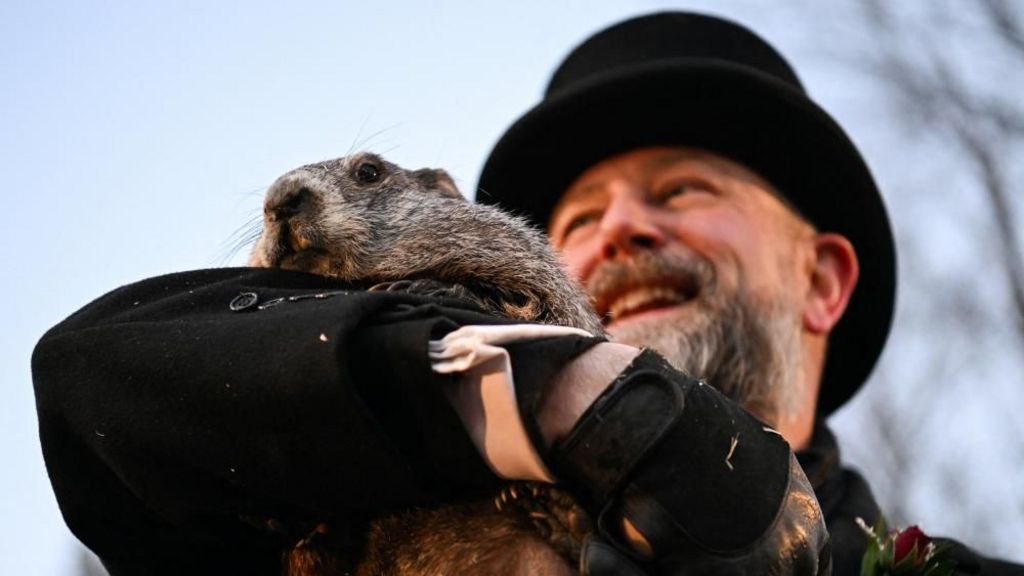
For over 135 years, the small Pennsylvania town of Punxsutawney has maintained an unusual meteorological tradition each February 2nd. Crowds gather before dawn at Gobbler’s Knob to witness the ceremonial extraction of a groundhog named Punxsutawney Phil from his temporary burrow. According to folklore dating back to 1887, if the rodent sees his shadow upon emergence, six additional weeks of winter weather will follow. Should no shadow appear, the prediction indicates an early arrival of spring.
The spectacle represents one of America’s most enduring cultural traditions, drawing thousands of attendees annually and generating significant media attention. The event incorporates elements of theater, with Phil’s handlers—members of the Punxsutawney Groundhog Club’s Inner Circle—claiming the same groundhog has been making predictions for over a century through a mysterious “elixir of life.”
Scientific analysis from the National Oceanic and Atmospheric Administration (NOAA) reveals substantial discrepancies between Phil’s predictions and actual weather patterns. Data compiled over the past two decades indicates the groundhog’s forecasts have demonstrated approximately 35% accuracy—a success rate barely exceeding random chance. Meteorological scientists emphasize that seasonal transitions depend on complex atmospheric conditions rather than rodent behavior.
Despite its questionable reliability, the tradition continues to thrive as a cultural phenomenon that blends folklore, community celebration, and tourism economics. The event has gained additional prominence through its depiction in the 1993 film “Groundhog Day,” which introduced the tradition to international audiences and embedded the phrase “Groundhog Day” in the cultural lexicon as a metaphor for repetitive experiences.