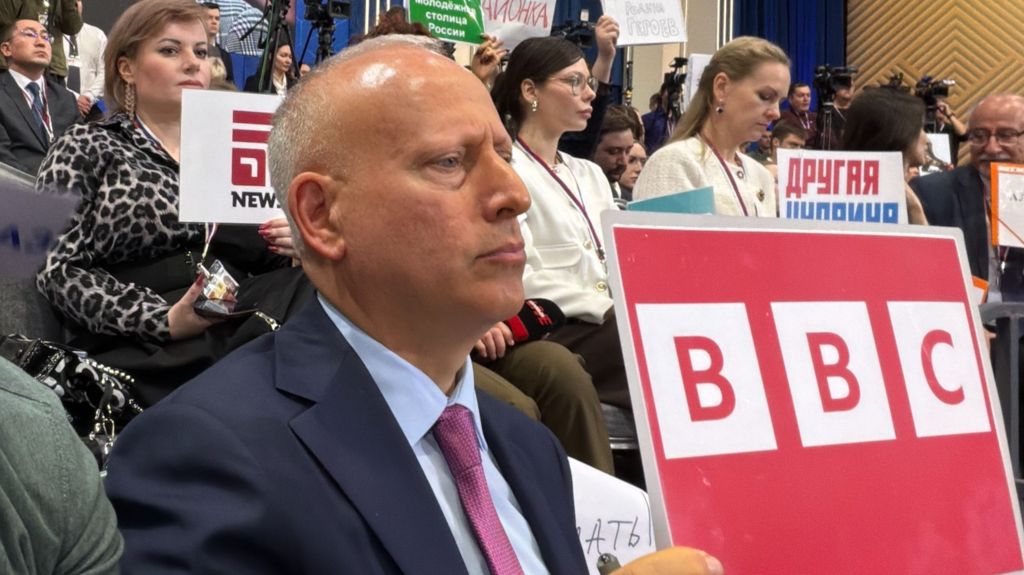
In a revealing account of contemporary media operations within Russia, BBC Moscow correspondent Steve Rosenberg details the increasingly hostile environment facing Western journalists. The situation has deteriorated markedly since Russia’s full-scale invasion of Ukraine in February 2022, creating what Rosenberg describes as a ‘legal minefield’ for foreign correspondents.
The hostility manifests through multiple channels, including vitriolic attacks on state-controlled television. Prominent presenter Vladimir Solovyov has personally targeted Rosenberg with derogatory remarks, labeling him ‘Steve Rotten-berg’ and comparing his appearance to a ‘defecating squirrel’ while explicitly branding him ‘a conscious enemy of our country.’
Operational challenges have intensified significantly. Journalists from nations designated ‘unfriendly’ by the Kremlin, including the United Kingdom, now face heightened scrutiny. Visa arrangements have been tightened, with accreditation requiring renewal every three months instead of the previous annual permits. Travel involves ‘additional checks’ at borders, creating constant administrative hurdles.
The legal landscape has become particularly perilous. The 2023 espionage conviction of Wall Street Journal reporter Evan Gershkovich, who spent sixteen months imprisoned despite widespread condemnation of the charges as fabricated, demonstrated that foreign citizenship provides no protection against detention. New repressive laws have silenced dissent and criminalized criticism of authorities, forcing many former Russian contributors to avoid Western media outlets entirely.
Despite these challenges, some access persists. Western broadcasters maintaining Moscow bureaus continue receiving invitations to Kremlin events, occasionally providing opportunities to question President Putin directly. These rare interactions offer insights into Moscow’s perspective, particularly Putin’s persistent resentment over NATO expansion and perceived Western disrespect toward Russian interests.
The geopolitical alignment has shifted notably with Donald Trump’s return to the American presidency. Moscow perceives improved relations with Washington, resulting in redirected media hostility toward European nations and the UK instead of the United States. This marks a dramatic reversal from the 1990s, when Rosenberg appeared on popular Russian television programs celebrating British culture and Allied cooperation during World War II.
The correspondent’s personal reflections highlight Russia’s contradictions: simultaneous hostility and warmth from different segments of society. While state media propagates antagonistic narratives, individual Muscovites continue expressing appreciation for Western journalists’ presence, embodying the nation’s double-headed eagle symbolism of conflicting orientations.