BRUSSELS — While European allies and Canada have committed substantial financial resources to support Ukraine and pledged significant defense budget increases, NATO’s fundamental credibility as a unified military alliance faces unprecedented challenges. Over the past year, trust within the 32-nation organization has deteriorated markedly, creating vulnerabilities that adversaries could potentially exploit.
The most visible fracture emerged from former U.S. President Donald Trump’s repeated threats to acquire Greenland, a semi-autonomous territory under Danish sovereignty and NATO membership. This was compounded by his derogatory comments regarding allied troops who served alongside American forces in Afghanistan. Although tensions surrounding Greenland have temporarily eased, security analysts warn these internal conflicts have substantially weakened the alliance’s deterrent capabilities.
Sophia Besch of Carnegie Europe think tank noted in an assessment: “This episode represents a fundamental breach that cannot be reversed. Even without implemented force or sanctions, this weakening of alliance cohesion has lasting consequences.”
Russia, identified as NATO’s primary security threat, has observed these transatlantic tensions with evident satisfaction. Russian Foreign Minister Sergey Lavrov commented last week: “It’s a major upheaval for Europe, and we are watching it,” while state media gleefully proclaimed the end of trans-Atlantic unity.
The core deterrence strategy against Russia relies on convincing President Vladimir Putin that NATO would respond unanimously if he expanded the conflict beyond Ukraine. Current internal divisions make such unified response increasingly uncertain.
In response to longstanding criticism about inadequate defense spending—particularly intense during the Trump administration—European allies and Canada agreed in July to invest 5% of GDP toward defense. This commitment includes 3.5% for core defense (matching current U.S. expenditure levels) and 1.5% for security infrastructure projects by 2035.
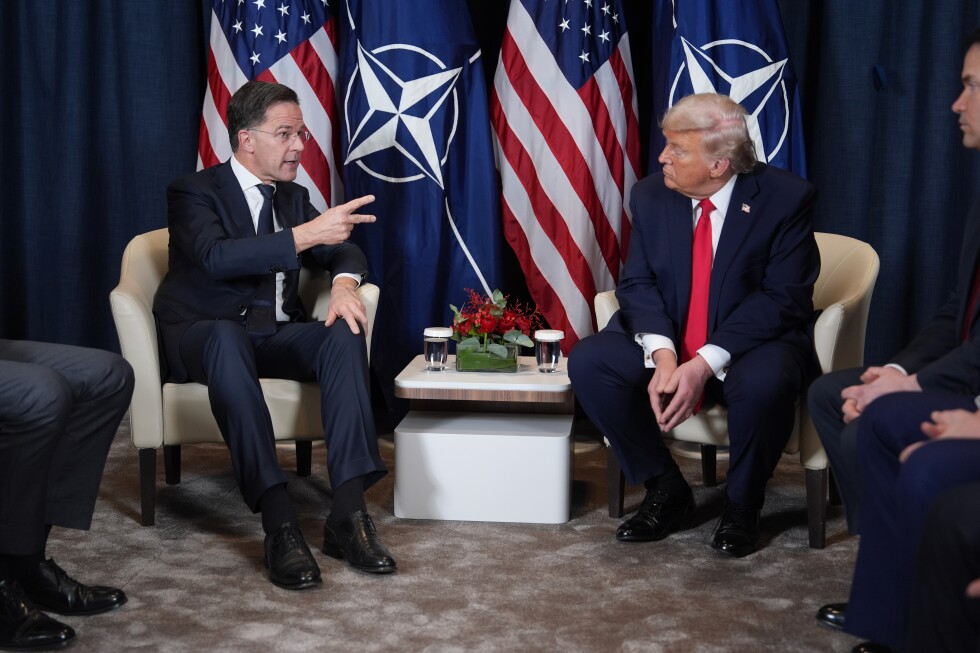
NATO Secretary-General Mark Rutte has praised these commitments as demonstrating the alliance’s strength, even crediting Trump with reinforcing NATO’s military capabilities. However, Rutte’s diplomatic approach toward the American leadership, including his avoidance of addressing the Greenland controversy, has raised concerns among observers.
The very foundation of NATO—established in 1949 to counter Soviet threats—rests on Article 5’s collective security guarantee that an attack on one member constitutes an attack on all. Trump’s territorial ambitions toward Greenland fundamentally challenged the principle of inviolable member territories, despite Article 5 not applying to internal disputes.
U.S. Senators Jeanne Shaheen (D) and Lisa Murkowski (R) warned in a joint statement: “Suggestions that the United States would seize or coerce allies to sell territory do not project strength. They signal unpredictability, weaken deterrence and hand our adversaries exactly what they want.”
Beyond territorial disputes, Trump’s expressed skepticism about mutual defense commitments has created profound uncertainty among European allies regarding American protection. This doubt extends to potential troop reductions in Europe, with upcoming NATO meetings expected to address Arctic security and possible U.S. troop drawdowns that could further undermine alliance cohesion.
A recent European Union Institute for Security Studies report cautioned that diminishing certainty about U.S. commitment to European security means “the deterrence edifice becomes shakier,” potentially encouraging adversaries to test NATO’s resolve through sabotage, cyberattacks, and escalation without fearing unified retaliation.