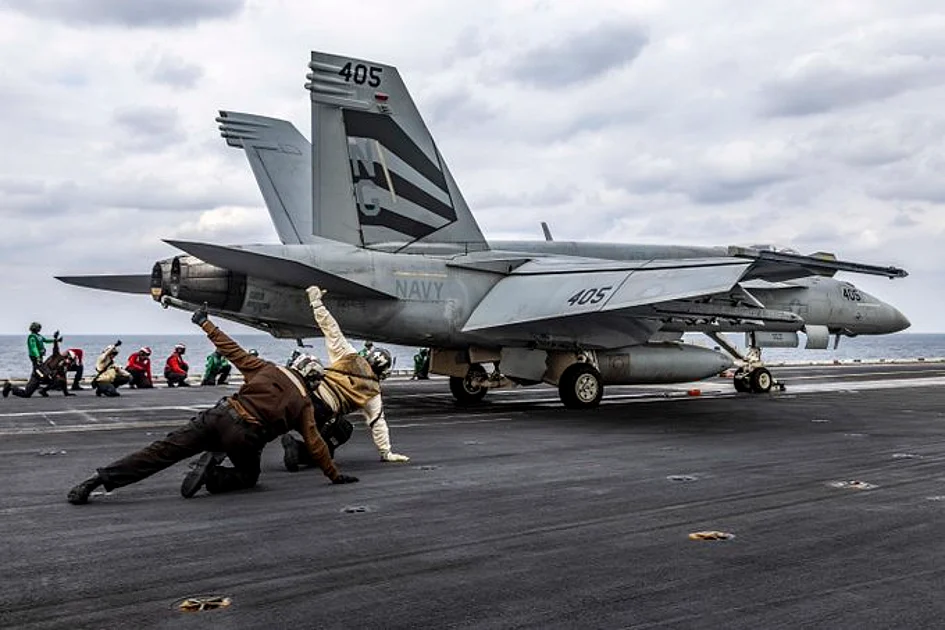
The United States has significantly bolstered its military presence in the Middle East with the deployment of the USS Abraham Lincoln carrier strike group to the Arabian Sea. This strategic movement comes amid escalating tensions between Washington and Tehran regarding Iran’s nuclear program.
On January 28, President Donald Trump issued a stern warning to Iranian leadership, emphasizing that time is running out for diplomatic resolution while referencing the approaching naval armada. The nuclear-powered aircraft carrier, accompanied by guided-missile destroyers including USS Spruance, USS Michael Murphy, and USS Frank E. Petersen Jr., represents a substantial enhancement of American firepower in the region.
The US Central Command confirmed the carrier’s position through operational imagery showing an F/A-18E Super Hornet launching from the flight deck during routine operations. The Nimitz-class vessel, commissioned in 1989, carries impressive specifications: spanning 333 meters in length, weighing 88,000 tonnes, and capable of speeds exceeding 30 knots while accommodating over 5,700 crew members.
The strike group’s air wing comprises advanced aircraft including F-35C Lightning II stealth fighters, FA/18 Super Hornets, EA-18G Growler electronic warfare planes, E-2D Hawkeye early warning aircraft, and MH-60 Seahawk helicopters for anti-submarine and anti-ship operations. This deployment marks one of the most significant US naval presences in the region recently, with ten American warships currently operating in Middle Eastern waters.
While administration sources indicate no final decision has been made regarding military action, the deployment serves as both a strategic deterrent and demonstration of capability amid ongoing diplomatic negotiations concerning Iran’s nuclear ambitions.