In a surprising policy reversal, prominent economic commentator Noah Smith advocates for the United States to permit the sale of Chinese electric vehicles despite previously supporting restrictive trade measures against China. This position emerges following Canada’s groundbreaking decision to dramatically reduce tariffs on Chinese-made EVs from 100% to 6.1%, while implementing import quotas starting at 49,000 units annually.
The Canadian-Chinese agreement represents a significant geopolitical divergence from US policy, which maintains 125% tariffs on Chinese EVs alongside bans on vehicles connected to Chinese software ecosystems. This separation reflects deteriorating US-Canada relations and Canada’s strategic calculation that reduced American auto investment in China diminishes the risks of policy independence.
Smith argues that American self-interest actually demands embracing Chinese EVs to accelerate the nation’s stalled electric transition. While global EV adoption accelerates, US progress has faltered due to terminated subsidies, Tesla’s declining popularity, and traditional automakers’ retreat from electric commitments. Ford recently announced $19.5 billion in charges related to scaling back EV ambitions, while General Motors recorded $1.6 billion in similar charges, and Stellantis abandoned plans for electric Ram pickups.
This retreat risks creating ‘Galapagos syndrome’ for American automakers, potentially isolating them from global markets as combustion engines become obsolete. More critically, failure to develop domestic electric technology capabilities threatens national security, since batteries and electric motors power essential military hardware including drones.
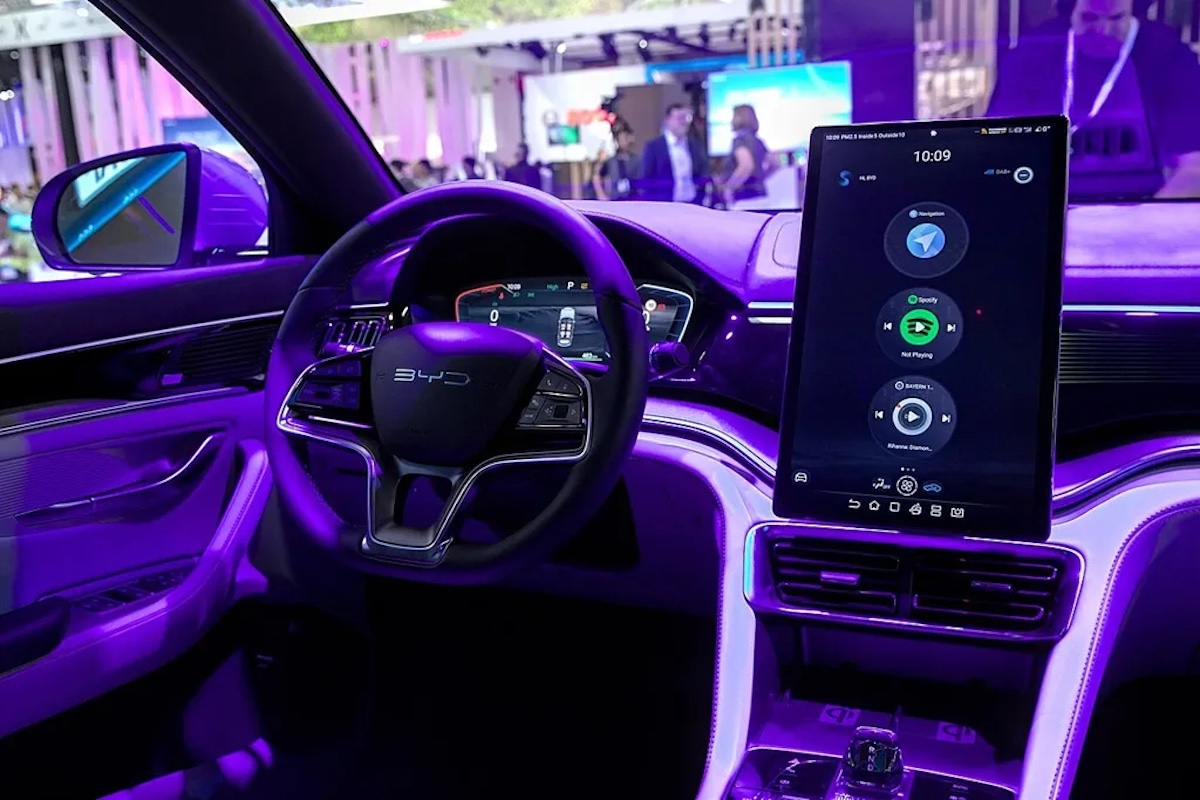
Chinese manufacturers offer sophisticated, affordable EVs featuring futuristic designs, ultra-fast charging, and semi-autonomous capabilities even in budget models. Their competitive pricing stems from complete domestic supply chains and massive production scale. Market evidence from Mexico demonstrates that even with 50% tariffs, Chinese EVs gain significant market share through superior quality and innovation.
Smith proposes that controlled admission of Chinese EVs would benefit America through multiple mechanisms: stimulating charging infrastructure development, demonstrating EV advantages to consumers, and forcing domestic manufacturers to innovate rather than retreat. Historical precedent exists in how Japanese automakers’ US expansion ultimately created 400,000 American jobs and transferred manufacturing expertise.
The commentary suggests implementing joint venture requirements and local content incentives to ensure technology transfer and component sourcing, potentially rebuilding America’s industrial capacity in critical electric technologies. Even former President Trump recently endorsed allowing Chinese automakers to establish US operations employing American workers.
While acknowledging legitimate cybersecurity concerns regarding data collection and potential sabotage capabilities, Smith contends these risks can be managed through monitoring requirements, domestic cloud hosting mandates, and component sourcing regulations rather than complete prohibition.
The analysis concludes that Canada has demonstrated a viable path forward that the US should refine and implement, recognizing that the benefits of controlled market access outweigh manageable security concerns in accelerating America’s electric transportation future.