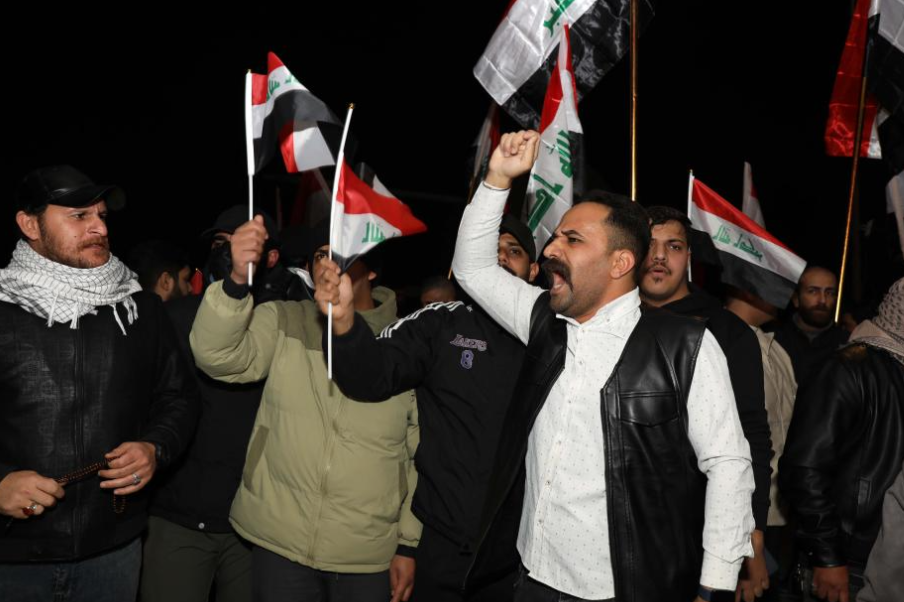
Central Baghdad witnessed significant public unrest on Wednesday evening as hundreds of Iraqi citizens mobilized near the heavily secured Green Zone to voice strong opposition against perceived United States interference in their nation’s political sovereignty. The demonstration, organized in response to escalating diplomatic tensions between Washington and Baghdad, saw protesters congregating near the Suspension Bridge adjacent to routes leading toward the US Embassy.
Participants chanted anti-American slogans while demanding complete preservation of Iraq’s autonomous decision-making capabilities regarding government formation. Although the protest remained predominantly peaceful, minor confrontations occurred when security personnel prevented demonstrators from advancing closer to embassy grounds. No casualties were reported during the event.
The catalyst for these demonstrations emerged from recent statements by US President Donald Trump, who explicitly warned that America would withdraw support from Iraq should former Prime Minister Nouri al-Maliki return to power. Trump cited substantive concerns regarding al-Maliki’s previous governance approaches and ideological orientations during his tenure from 2006 to 2014.
In a firm rebuttal, al-Maliki condemned what he characterized as ‘blatant US interference’ in Iraq’s domestic affairs, asserting that such actions violated national sovereignty and undermined democratic processes established post-2003. His comments came shortly after the Coordination Framework (CF) – an alliance of Shiite parties representing the largest parliamentary bloc – formally nominated him for a third premiership term last Saturday.
Iraq operates under a unique power-sharing structure instituted following the 2003 regime change, which reserves governmental positions among major ethno-sectarian groups: the presidency for Kurds, parliamentary speakership for Sunni Muslims, and prime ministership for Shiite Muslims. This protest highlights deepening sensitivities surrounding foreign influence in Iraq’s delicate political equilibrium.