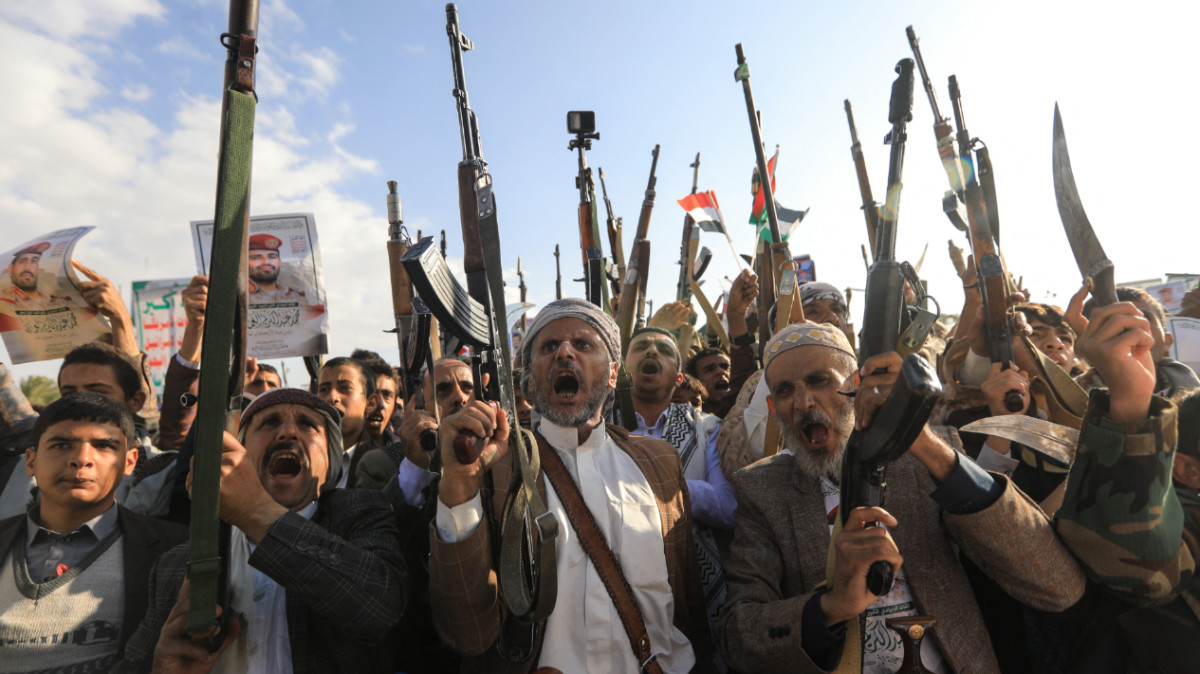
Iran-aligned paramilitary forces across the Middle East have issued stark warnings of potential retaliation against any American military action targeting the Islamic Republic. The escalating tensions emerge as the Trump administration deliberates possible precision strikes against Iranian officials deemed responsible for protester casualties.
In Iraq, Kataib Hezbollah leader Abu Hussein al-Hamidawi declared readiness for “total war” in a Sunday statement, threatening that enemies “will taste every form of deadly suffering” and promising to eliminate all US presence from the region. Simultaneously, Yemen’s Houthi movement released a provocative video暗示 the resumption of maritime attacks in the Red Sea, captioned simply “Soon.”
The geopolitical landscape reflects heightened vulnerability for US forces, with approximately 40,000 American troops stationed throughout the Middle East. Critical bases in Iraq, Syria, and particularly Gulf states like Kuwait, Qatar, UAE, Bahrain, and Saudi Arabia represent potential flashpoints. Several Arab governments have actively lobbied against US military action, fearing regional escalation.
Military preparedness indicators show significant US mobilization, including the redeployment of the Abraham Lincoln aircraft carrier strike group from the South China Sea to the Middle East, accompanied by F-35 and F/A-18 fighter squadrons. Open-source intelligence also reveals F-15 warplane reinforcements at Jordan’s Muwaffaq Salti Air Base.
The current tensions recall earlier confrontations in 2025, when direct conflict occurred between the US, Israel, and Iran, including US bombing of Iranian nuclear facilities. The January 2024 drone strike in Jordan that killed three US soldiers remains a recent precedent for militia capabilities.
Regional dynamics have shifted substantially since the 2023 Hamas-led attack on Israel and subsequent Gaza conflict. Iranian proxy networks have experienced significant transformations, with Lebanese Hezbollah particularly degraded following the assassination of leader Hassan Nasrallah and subsequent disarmament agreements. This has elevated the strategic importance of Iraqi militias like Kataib Hezbollah within Iran’s regional strategy.
The so-called “axis of resistance” exhibits varying degrees of independence from Tehran, with Iraq’s Popular Mobilization Forces integrated into state structures, Hezbollah maintaining political influence in Lebanon, and the Houthis operating with considerable autonomy in Yemen. The Houthis have emerged particularly strengthened from recent conflicts, having maintained missile capabilities against Israel despite a May 2025 truce with the US.
Current administration discussions have been characterized as “chaotic” amid concerns about potential escalation consequences, reflecting the complex calculations surrounding any military action against Iran and its regional network.