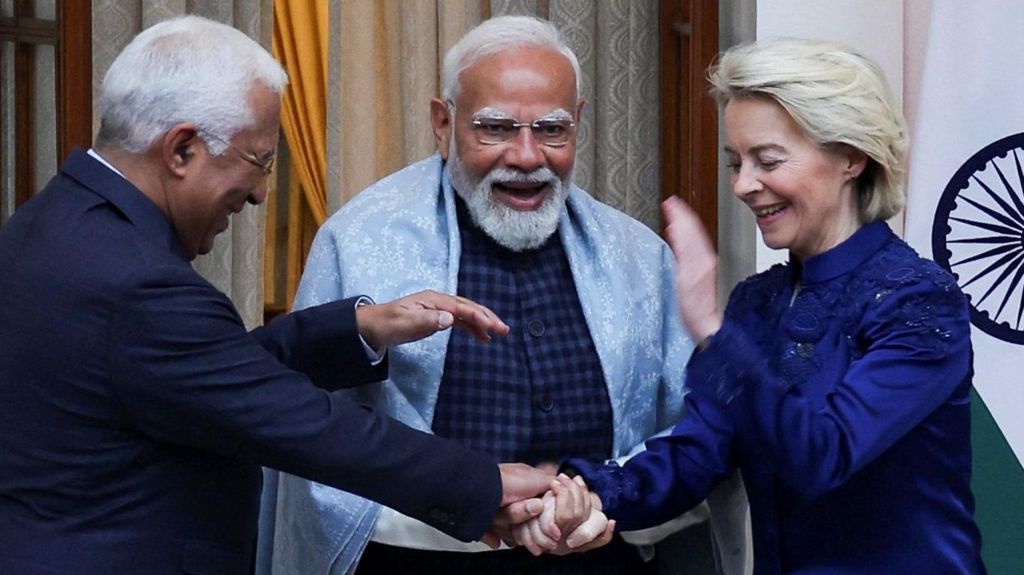
In a landmark development with profound geopolitical implications, India and the European Union have concluded negotiations on a comprehensive free trade agreement, signaling a strategic realignment in response to global economic uncertainties. The deal, hailed as “the mother of all deals” by both Indian Prime Minister Narendra Modi and European Commission President Ursula von der Leyen, represents a significant breakthrough after two decades of stalled negotiations.
The agreement emerges against a backdrop of escalating trade tensions and unpredictable US policy under the Trump administration. With the US imposing 50% tariffs on Indian goods—including a 25% penalty for India’s continued purchase of Russian oil—and threatening similar measures against EU countries, both powers have sought to diversify their economic partnerships and reduce strategic dependencies.
Von der Leyen emphasized the partnership’s significance, stating: “This is the tale of two giants – the world’s second and fourth largest economies – choosing partnership in a true win-win fashion. By combining our strengths, we reduce strategic dependencies at a time when trade is increasingly weaponized.”
Prime Minister Modi highlighted the agreement’s broader implications, noting that the global order is in “great turmoil” and that the pact would strengthen global supply chains while serving as “a new blueprint for shared prosperity.”
The deal forms part of a broader pattern of nations seeking alternative alliances amid Washington’s aggressive trade stance. Recent weeks have seen Canada resetting ties with China, the UK pursuing strengthened trade relations with Beijing, and the EU finally concluding a trade accord with Mercosur after 25 years of negotiation—all developments experts attribute partly to the “Trump factor.”
Michael Kugelman, senior fellow for South Asia at the Atlantic Council, observed: “The Trump factor provided a very strong impetus to the deal because both India and the EU are facing shock US tariffs that they never expected. Trump is a big reason why the EU and India have been able to overcome most of their differences.”
While the agreement promises enhanced market access for both parties and helps the EU reduce its reliance on China, implementation challenges remain. The deal must undergo months of legal scrutiny before ratification by EU member states and the European Parliament—a process experts warn will be complex given contentious issues around intellectual property, agriculture, and carbon emissions.
Despite these hurdles, business groups on both sides have welcomed the agreement as a crucial step toward stabilizing trade relations in an increasingly volatile global landscape.