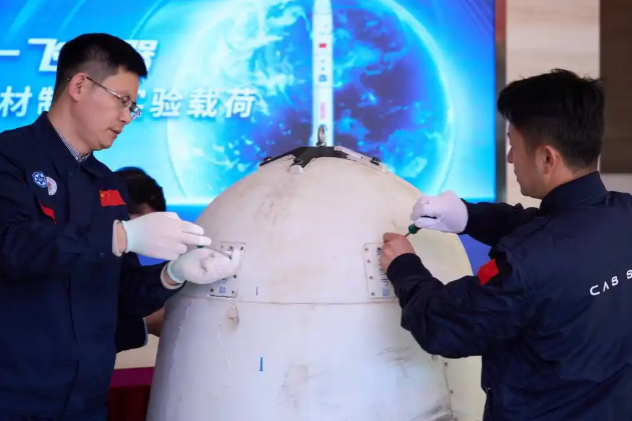
China has marked a historic milestone in space technology by successfully executing the first-ever metal 3D printing experiment in orbit. This groundbreaking achievement represents a quantum leap in the nation’s extraterrestrial manufacturing capabilities and positions China at the forefront of space-based industrial technology.
The pioneering experiment was conducted aboard the Lihong-1 Y1 suborbital vehicle, a commercially developed recoverable spacecraft designed for space tourism operations. Following its successful inaugural test flight from the Jiuquan Satellite Launch Center on January 12th, the spacecraft carried specialized scientific equipment developed by the Institute of Mechanics under the Chinese Academy of Sciences (CAS).
Upon crossing the Kármán line—the internationally recognized boundary separating Earth’s atmosphere from outer space—at an altitude of approximately 120 kilometers, the payload autonomously fabricated metal components under microgravity conditions. This successful demonstration transitions China’s metal additive manufacturing technology from theoretical ground-based research to practical in-space engineering verification.
The CAS emphasized the extraordinary complexity of conducting metal additive manufacturing in space, where factors such as microgravity, extreme temperatures, and vacuum conditions present significant engineering challenges. Research teams overcame critical obstacles including stable material transport and formation processes, full-process closed-loop control systems, and ensuring high-reliability coordination between the experimental payload and launch vehicle.
Following completion of the experiment, the payload capsule successfully returned to Earth via parachute-assisted landing, delivering invaluable firsthand data to scientists. Researchers have obtained crucial information regarding melt pool dynamics, material transport mechanisms, solidification behavior, and the geometric precision and mechanical properties of space-manufactured components.
The Lihong-1 Y1 vehicle, noted for its cost-effectiveness and operational flexibility, has demonstrated its capability as a reliable platform for space technology verification. This breakthrough is expected to significantly accelerate the development of China’s space manufacturing capabilities and serve as a critical enabler for future orbital infrastructure development, potentially revolutionizing how space missions approach manufacturing, repair, and construction beyond Earth.