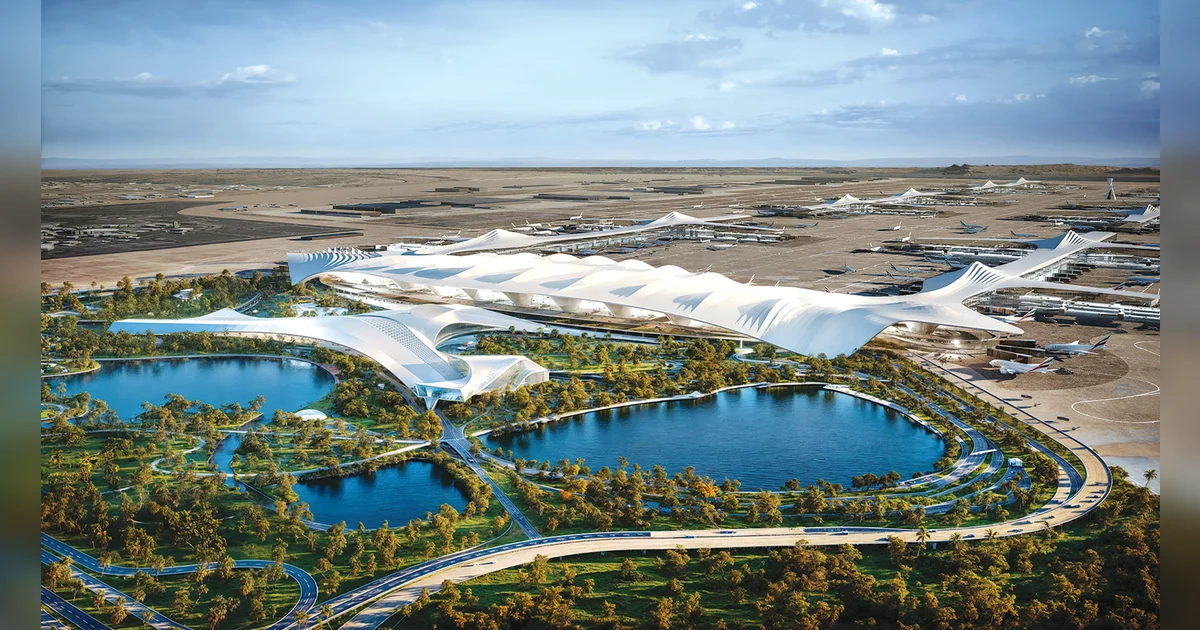
The Gulf Cooperation Council (GCC) is poised to revolutionize global aviation infrastructure with unprecedented investments exceeding $100 billion in airport development projects. These strategic initiatives will enable the region’s airports to accommodate over 500 million passengers annually within the next decade, fundamentally reshaping international travel patterns and economic dynamics.
According to aviation experts and industry analysts, this transformation is driven by massive fleet expansions and cutting-edge technological implementations that will enhance route networks, operational efficiency, and passenger experiences. The development includes mega-hubs in Dubai and Riyadh alongside significant expansions of secondary airports in Abu Dhabi, Sharjah, Jeddah, Doha, and Muscat.
Recent data reveals remarkable growth trajectories, with the top ten Gulf airports recording an 11% year-on-year increase in passenger traffic, handling 327 million travelers in 2024 compared to 293 million in 2023. The aviation sector has evolved from merely supporting economic growth to becoming a primary engine of economic transformation across GCC nations, deeply integrated into national diversification strategies and labor markets.
Saudi Arabia has committed approximately $50 billion to aviation infrastructure, including the ambitious King Salman International Airport in Riyadh. Meanwhile, Dubai is developing the $35 billion Al Maktoum International Airport, which upon completion will be five times larger than Dubai International Airport (DXB) with capacity for 260 million passengers annually. DXB itself is projected to exceed 96 million passengers this year, approaching its maximum capacity.
Smaller GCC states are pursuing specialized niches in cargo, multimodal logistics, and tourism connectivity. Oman has announced plans for six new airports by 2028-29, Kuwait’s Terminal 2 expansion will increase capacity to 25 million passengers, and Bahrain is planning a greenfield facility on a reclaimed island as current infrastructure reaches its limits.
Technological innovation represents a cornerstone of this transformation. GCC airports are implementing facial recognition systems, AI-driven solutions, advanced biometric processing, and streamlined security protocols that will eliminate the need for removing liquids and laptops during screening. These developments promise to reduce processing times dramatically, potentially enabling passengers to move from airport entry to departure gates within minutes.
Despite these advancements, significant challenges remain. The concentration of passenger demand within compressed timeframes intensifies competition for skilled professionals across multiple markets. The logistical complexity of transitioning operations from DXB to Al Maktoum International Airport presents substantial operational hurdles. Additionally, regional geopolitical tensions and infrastructure constraints at expanding airports pose ongoing concerns.
The competitive landscape extends beyond the GCC, with developments in Turkey’s Istanbul airport and India’s new facilities in Delhi and Mumbai representing additional market pressures. Nevertheless, the GCC’s strategic investments in aviation infrastructure position the region to maintain its leadership in global aviation connectivity and economic diversification for decades to come.