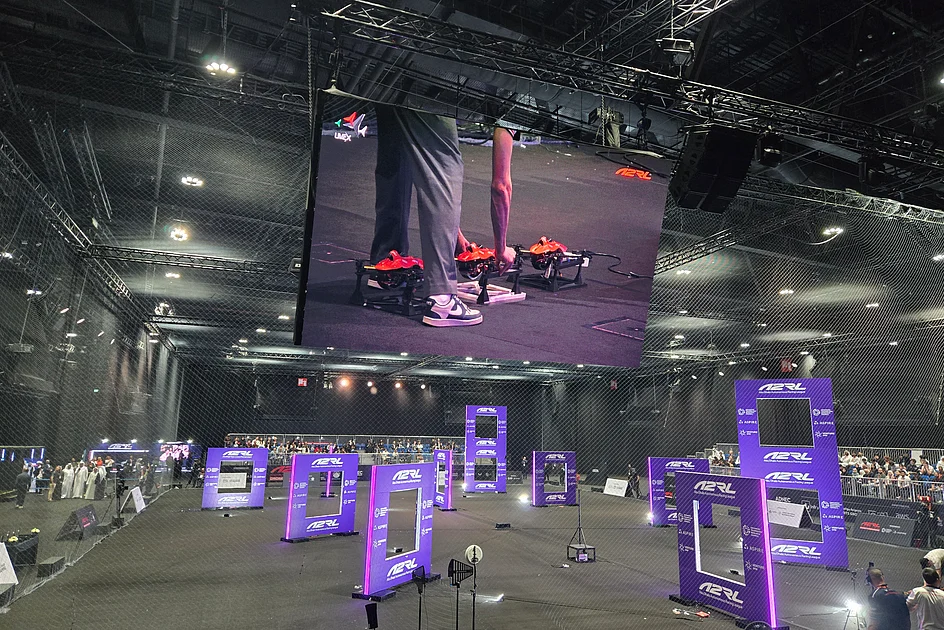
In a stunning reversal of expectations at the ADNEC Centre Abu Dhabi, South Korean FPV pilot Minchan Kim defeated an autonomous drone system in a gripping best-of-nine finale at the A2RL Drone Championship. The historic matchup, held on January 22, 2026, saw human intuition ultimately prevail against machine precision in what organizers describe as a critical testing ground for autonomous systems.
The championship’s climax unfolded with tactical sophistication as Kim employed a strategy of calculated patience against TII Racing’s AI drone. Rather than challenging the autonomous system’s superior speed directly, the human pilot maintained consistent flight patterns through the obstacle course gates, capitalizing on rare but decisive errors by the AI competitor. The contest reached its peak at a tense 4-4 tie, forcing a final heat that captivated spectators and professional pilots alike.
Kim revealed the psychological intensity of competing against artificial intelligence: ‘When I fly with AI, I see the autonomous drone in my camera view, and it generates significant psychological pressure. The turbulence from nearby drones created additional aerodynamic challenges that required constant mental composure.’ His preparation involved both technical precision in drone positioning and deliberate psychological conditioning, repeating self-affirmations before each launch.
While human pilots demonstrated superior recovery capabilities, the Technology Innovation Institute’s autonomous system established itself as the world’s fastest racing drone. Senior researcher Aaesha Al Shehhi acknowledged her team’s relatively recent entry into the field compared to human pilots with decade-long experience: ‘The privilege that human pilots have is their ability to recover from errors mid-flight. Our systems cannot yet replicate this adaptive capability when encountering unexpected conditions.’
The event also featured a groundbreaking demonstration of simultaneous four-drone autonomous racing, marking a world first in coordinated AI flight systems. Although the formation quickly devolved due to sensor limitations and aerodynamic interference, the demonstration highlighted both the potential and current constraints of multi-drone autonomy.
Organized by ASPIRE, the innovation arm of Abu Dhabi’s Advanced Technology Research Council, the championship serves as a real-world laboratory pushing autonomous systems beyond theoretical capabilities. The competition forms part of the broader Unmanned Systems Exhibition, where defense, aerospace and technology entities converge to advance autonomous mobility research.
Despite human victory in this iteration, researchers emphasize the rapidly narrowing gap between human and artificial performance in extreme environments. The data collected from these high-speed encounters directly informs the development of more resilient autonomous systems capable of handling real-world unpredictability.