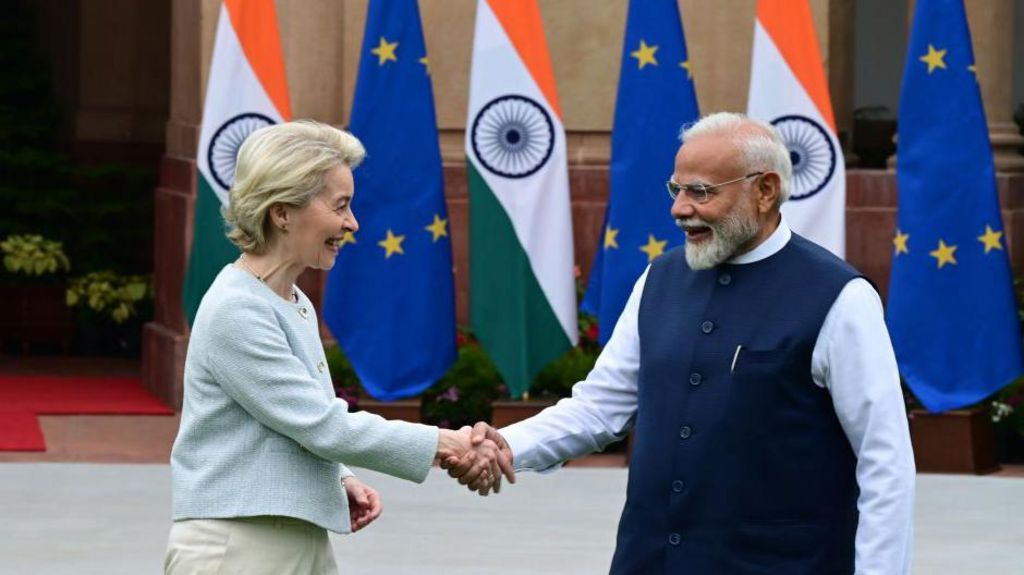
In a significant diplomatic development, European Council President Antonio Luis Santos da Costa and European Commission President Ursula von der Leyen will attend India’s Republic Day celebrations as chief guests on January 26th. Beyond the ceremonial honors, their visit marks a crucial juncture in nearly two decades of free trade negotiations between the European Union and Asia’s third-largest economy.
The potential agreement, which some reports suggest could be announced as early as January 27th during a high-level summit, represents a strategic pivot for both parties. For India, this constitutes its ninth free trade pact in four years, following recent deals with the UK, Oman, and New Zealand. The EU, meanwhile, continues expanding its trade network after concluding agreements with Mercosur nations, Japan, South Korea, and Vietnam.
This accelerated negotiation timeline occurs against a backdrop of global trade uncertainty. Recent geopolitical tensions, including former President Donald Trump’s threatened tariffs against European allies and ongoing US-India trade disputes, have created renewed urgency for both parties to secure reliable trading partnerships. As Chietigj Bajpaee of Chatham House notes, “It sends a signal that India maintains a diversified foreign policy and that it is not beholden to the whims of the Trump administration.”
The economic stakes are substantial. The EU is already India’s largest trading bloc, with bilateral trade currently favoring India—$76 billion in exports versus $61 billion in imports. The agreement would restore Generalized System of Preferences (GSP) benefits withdrawn in 2023, potentially boosting Indian exports in garments, pharmaceuticals, steel, petroleum products, and machinery.
For Europe, partnering with the world’s fourth-largest and fastest-growing major economy—projected to surpass Japan’s GDP this year—offers access to a massive consumer market. Von der Leyen previously emphasized that an EU-India partnership would create a free market of two billion people accounting for a quarter of global GDP.
Nevertheless, significant challenges remain. Europe seeks stronger intellectual property protections, including enhanced data security and patent regulations. India faces concerns regarding the EU’s new Carbon Border Adjustment Mechanism (CBAM), which effectively imposes border charges on Indian exports regardless of FTA provisions—particularly burdensome for small and medium-sized enterprises.
India is expected to protect sensitive sectors like agriculture and dairy, while gradually reducing tariffs on automobiles, wine, and spirits—a approach consistent with previous trade agreements. As analyst Sumedha Dasgupta observes, the deal represents “a continuing and significant effort to shed India’s notoriously protectionist carapace.”
Despite these hurdles, analysts ultimately view the agreement as mutually beneficial. Alex Capri of the National University of Singapore notes that the pact could “expedite trade decoupling from unreliable partners,” reducing vulnerabilities to arbitrary tariffs and weaponized supply chains. The agreement may also benefit from improved EU-India relations following India’s reduction of Russian crude oil purchases since November 2025.
As Dasgupta concludes, recent political friction with the US means “EU leaders will now be more welcoming towards this trade deal than they would have otherwise been,” suggesting favorable conditions for finalizing this long-anticipated agreement.