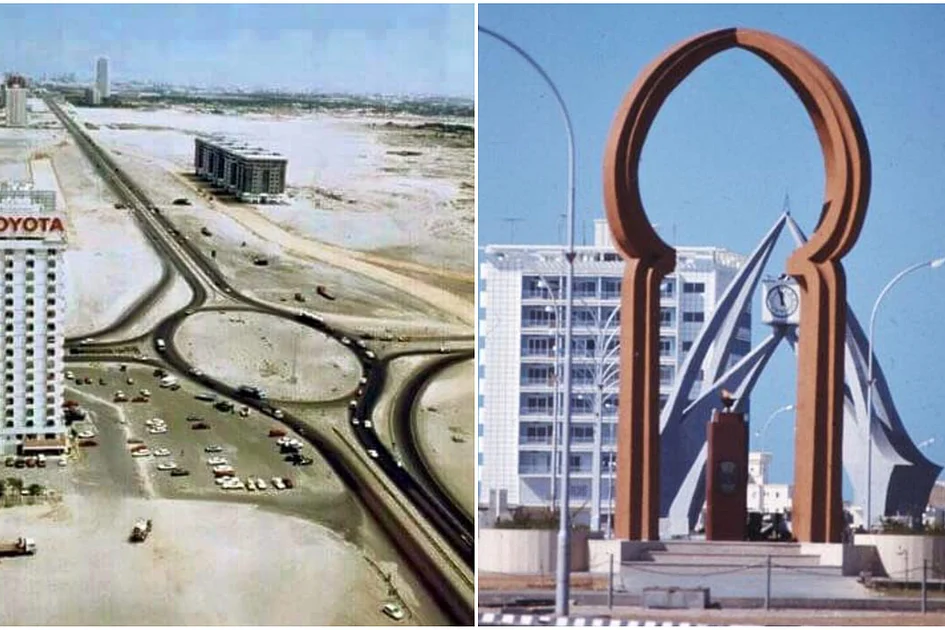
In the ever-evolving urban landscape of Dubai, a fascinating cultural phenomenon persists: the enduring legacy of vanished landmarks in everyday navigation. Long before digital mapping systems and Makani codes defined wayfinding, residents relied on physical structures—cinemas, roundabouts, and distinctive buildings—as directional anchors.
This persistence of historical reference points reveals much about urban memory and adaptation. The ongoing reconfiguration of Trade Centre Roundabout exemplifies this trend. Despite the Roads and Transport Authority’s conversion of this junction into a surface intersection to alleviate congestion, many residents and taxi drivers continue referring to it as ‘Defence Roundabout,’ preserving a name that predates the current layout.
Emirati cultural consultant Mohammad Kazim explains this phenomenon through Dubai’s transient population dynamics: ‘Landmarks mattered. They were how you explained the city to someone who didn’t know it yet.’ This oral tradition has created a parallel navigation system where demolished structures maintain their directional utility.
Examples abound throughout the city: Strand Cinema, demolished in the 1990s, still surfaces in Bur Dubai directions; Deira’s ‘Clock Roundabout’ remains a common reference despite traffic lights replacing the circular junction; and Garhoud’s Falcon Roundabout persists verbally long after the sculpture’s relocation to Mirdif Park.
British expat Josephine Finzi recalls pre-digital navigation: ‘We got around by visual clues—past Spinneys on the beach road, left at the zoo, right at the clock tower.’ These references created a shared geographical language that transcended physical changes.
The pattern extends beyond roundabouts. Peter Halliday, resident since 1982, remembers when the World Trade Centre served as a visible beacon: ‘You could see it from tens of kilometres away.’ Len Chapman, who arrived in 1971, traces roundabout culture to British architect John Harris’s 1959 town plan, which introduced these ‘punctuation marks’ to Dubai’s urban grammar.
Even commercial establishments like the Sana Signal clothing store, closed since 2018, continue as directional markers in Bur Dubai and Karama. Online communities like ‘Dubai — The Good Old Days’ actively preserve this collective memory through photographs and discussions, creating digital archives of the city’s changing physical identity.
This navigation-by-memory system demonstrates how urban consciousness adapts to rapid development, maintaining continuity through language even as physical landscapes transform beyond recognition.