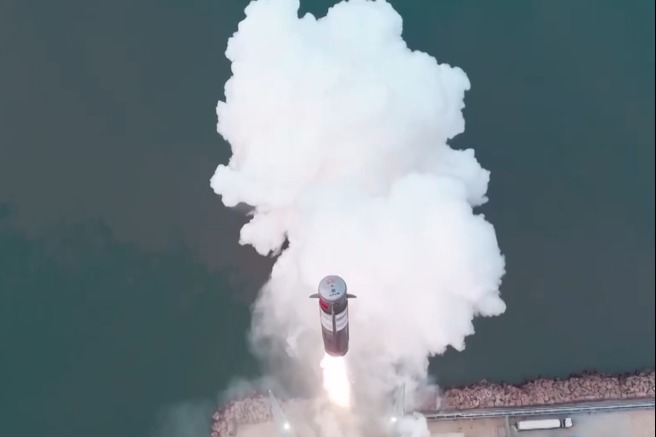
China is poised to activate its pioneering offshore infrastructure dedicated to testing reusable liquid-propellant rockets, marking a transformative advancement in the nation’s commercial spaceflight capabilities. Situated at the Oriental Aerospace Port in Haiyang, Shandong Province, this facility represents China’s sole commercial maritime launch base and is currently undergoing final construction preparations.
According to a China Media Group report, the platform is scheduled to commence trial operations around February 5, 2026, preceding the country’s inaugural maritime launch and recovery attempt of a commercial liquid rocket during the Chinese New Year period. This strategic initiative addresses the fundamental commercial space challenge of achieving cost-effective, frequent orbital access through rocket reusability.
The technical sophistication of the facility is evident in its specialized infrastructure. A hydraulic erector system featuring four large cylinders will maneuver rockets weighing hundreds of tonnes from horizontal to vertical positioning. Critical safety systems include a 17-meter-deep flame trench designed to redirect exhaust plumes exceeding 3,000 degrees Celsius during ignition, complemented by an advanced water deluge system for thermal management and acoustic suppression.
This development builds upon Haiyang’s established launch legacy, having successfully executed 22 sea launches deploying 137 satellites using solid-fuel rockets. The transition to liquid propulsion systems signifies a substantial technological leap, offering superior payload capacity and the reusability essential for scalable satellite constellation deployments.
The platform integrates within a comprehensively planned zone featuring propellant storage facilities for liquid oxygen, liquid nitrogen, kerosene, and methane, supporting next-generation rocket operations. This infrastructure forms a crucial component of Shandong’s expanding aerospace ecosystem, encompassing launch services, rocket manufacturing, and satellite applications across multiple cities.
This progress aligns with China’s three-year (2025-2027) action plan to enhance commercial space development, integrating it within national space strategy while fostering innovative productive forces. Recent data from the China National Space Administration reveals substantial growth in commercial space activities, with 50 commercial launches conducted in 2025—representing 54% of China’s total space missions—and 311 commercial satellites deployed, accounting for 84% of all Chinese satellites launched that year.