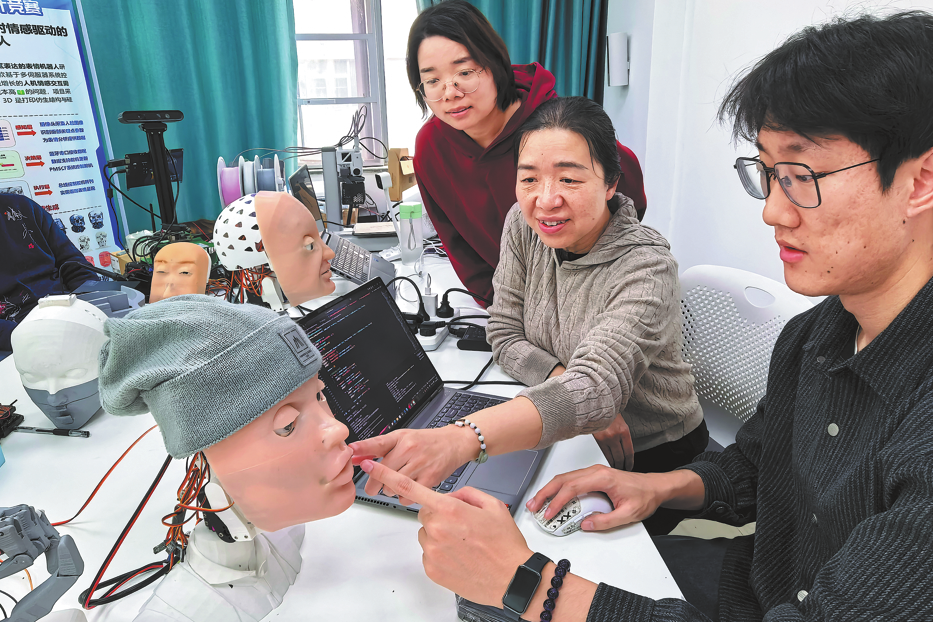
A groundbreaking advancement in human-robot interaction has emerged from Wuhan’s Huazhong University of Science and Technology, where engineers have developed a sophisticated system capable of decoding and replicating complex human emotions with unprecedented accuracy. Led by Professor Yu Li, the research team has created algorithmic technology that analyzes subtle facial muscle movements to interpret emotional states, representing a significant leap forward in bridging the communication divide between humans and machines.
The system operates by identifying distinct facial “action units” – minute muscular contractions around the eyes, nose, and mouth that form the visual language of human expression. Through high-precision algorithms, the technology can recognize seven fundamental emotions (anger, disgust, fear, happiness, sadness, surprise, and neutral) with 95% accuracy in real-world conditions. More impressively, it deciphers 15 compound expressions – blended emotional states like ‘happily surprised’ or ‘fearfully disgusted’ – with 70% precision, a rate described as exceptional within current AI capabilities.
Professor Yu explains the technological breakthrough: “The human face contains dozens of action units corresponding to specific muscle movements. While happiness typically involves raised cheeks and upturned mouth corners, anger manifests through furrowed brows and tightened eyelids. Our system captures these detailed movements while filtering out individual physiological variations, enabling accurate emotional categorization.”
The innovation extends beyond digital recognition into physical embodiment. The team’s robots feature 20 movable facial points that combine through specialized mechanical systems to produce naturalistic expressions. Unlike traditional robots limited to simplistic mouth movements, these machines achieve three-dimensional lip motion capable of reproducing 46 phonemes and nearly 20 distinct mouth shapes. Enhanced linkage mechanisms for nasal alae, cheeks, and malar regions enable subtle expressions like laughing and crying without the unnatural “segmented movement” typical of robotic faces.
Real-world applications are already underway. The technology has been deployed in dozens of Chinese schools as digital psychological consultants that adjust responses based on students’ facial cues. In residential communities, these robots serve as emotional companions for isolated seniors, providing “natural, credible and comfortable” interactions when human companionship is unavailable. Expansion into commercial spaces, banking environments, and metaverse platforms is anticipated in the near future.
Despite these advancements, Professor Yu emphasizes an important distinction: “Understanding emotion does not mean the robot itself has emotions. This technology provides care and support functions but should never replace genuine human social exchanges.” The research earned second prize in Hubei province’s technological invention awards in January, signaling recognition for its potential to transform human-machine interaction while maintaining ethical boundaries.