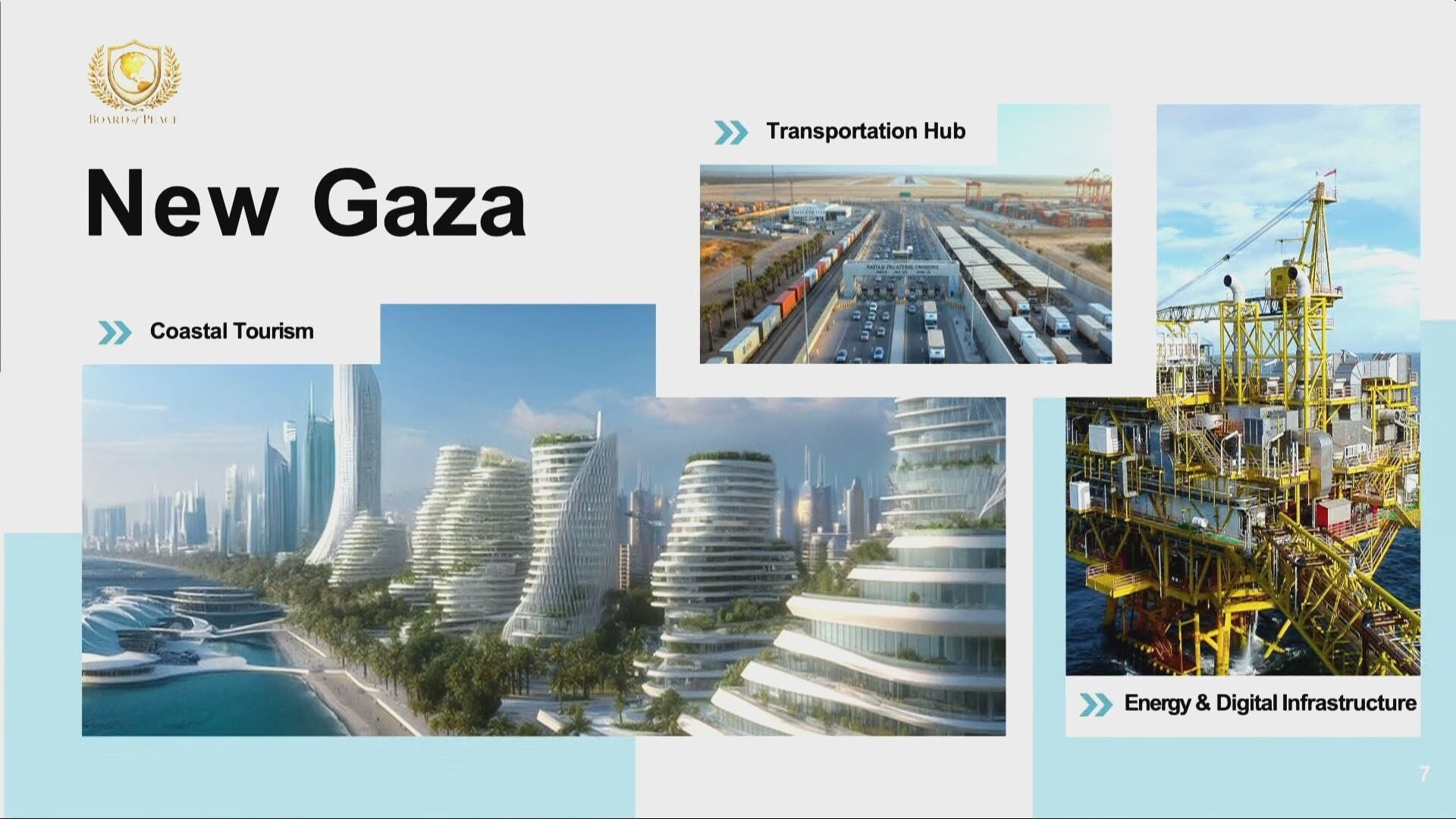
At the World Economic Forum in Davos, Jared Kushner, former senior advisor to President Donald Trump, presented a comprehensive blueprint for the economic transformation of Gaza based on free market principles. The detailed proposal, estimated at $25 billion, outlines a six-phase development plan starting in southern Gaza and progressing northward.
The reconstruction initiative envisions creating modern urban infrastructure including high-rise coastal towers, business districts, industrial zones with advanced manufacturing facilities, and extensive transportation networks featuring new airports, ports, and logistics corridors. The plan specifically designates areas for coastal tourism along Gaza’s coastline with proposals for 180 mixed-use towers, alongside residential neighborhoods and industrial zones containing data centers.
A significant $3 billion investment fund would be allocated for commercial zones, business districts, and grants to stimulate local enterprise. The ‘New Rafah’ component alone proposes constructing 100,000 housing units, over 200 educational centers, 75 medical facilities, and 180 cultural, religious, and vocational centers.
Kushner emphasized that implementation would only commence following complete demilitarization of Hamas, with provisions for amnesty and reintegration of some members into a new Palestinian police force after rigorous vetting. The proposal projects Gaza’s GDP could reach $10 billion by 2035, with average household income exceeding $13,000 annually.
The plan was introduced during the charter signing for Trump’s ‘Board of Peace,’ which requires member nations to contribute $1 billion for permanent membership. The board, which would be chaired for life by Trump, has extended invitations to approximately 50 countries, though several nations including France, Norway, and Ukraine have expressed reservations or declined participation, particularly concerning Russia’s potential involvement.
Palestinian-American writer Susan Abulhawa criticized the proposal on social media, arguing it would ‘erase Gaza’s indigenous character’ and transform residents into ‘a cheap labor force.’ Notably, no Palestinian representatives are included in the proposed governance structure.