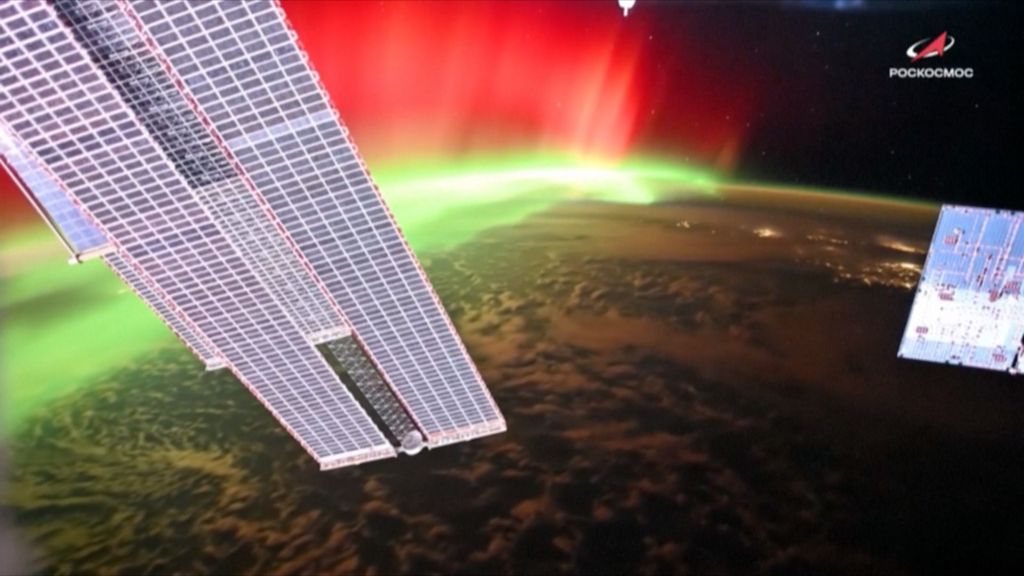
Russian cosmonaut Sergey Kud-Sverchkov has documented one of space’s most breathtaking phenomena from the unique vantage point of the International Space Station. His recently released footage showcases an intense auroral display dancing across Earth’s atmosphere during what scientists have identified as the most significant solar storm event in over two decades.
The spectacular visual records were captured as our planet experienced heightened geomagnetic activity resulting from powerful solar eruptions. These celestial disturbances created ideal conditions for the vibrant aurora borealis, typically visible only in polar regions, to extend to unusually low latitudes.
From his orbital perspective 400 kilometers above Earth, Kud-Sverchkov’s imagery provides unprecedented detail of the luminous phenomenon. The footage reveals the full spectral dimension of the aurora, with shimmering green ribbons intertwined with rare crimson hues, creating an otherworldly corona effect around our planet’s curvature.
Space weather experts at NASA and Roscosmos confirm this event represents a G4-class geomagnetic storm, ranking as ‘severe’ on the space weather scale. Such intense solar activity originates from coronal mass ejections – massive expulsions of plasma and magnetic field from the Sun’s corona that travel through interplanetary space before interacting with Earth’s magnetosphere.
The scientific community emphasizes that while these storms create visual marvels, they also demonstrate the importance of monitoring space weather due to potential impacts on satellite operations, communication systems, and power grids. Kud-Sverchkov’s documentation contributes valuable observational data to ongoing research in heliophysics and atmospheric sciences.