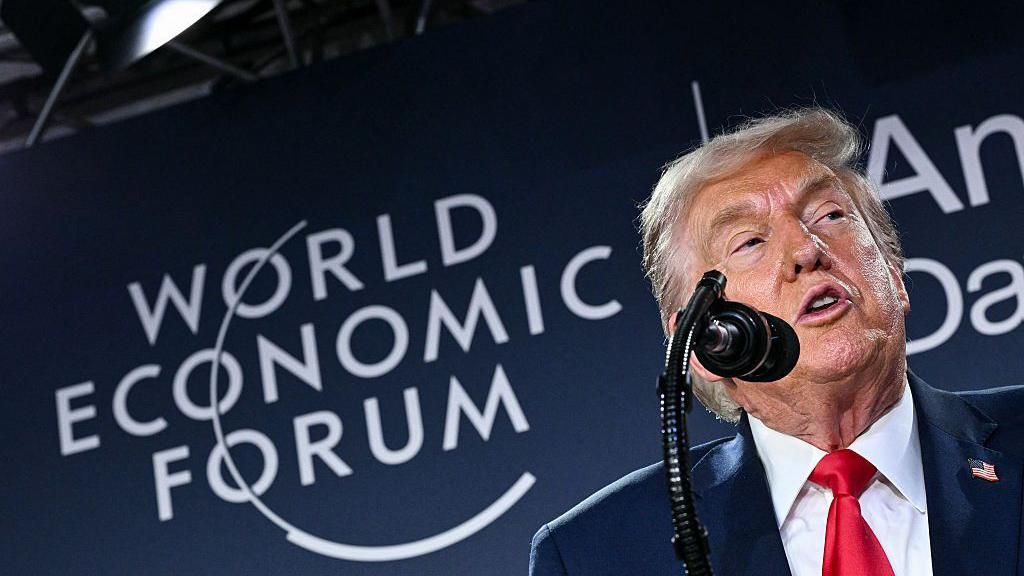
At the World Economic Forum in Davos, Switzerland, U.S. President Donald Trump delivered a contentious speech that further strained relations with European allies. His remarks, which combined historical revisionism with territorial ambitions, left European delegates visibly unsettled.
Trump asserted that without American intervention, Europe ‘would all be speaking German,’ overlooking that German is actually one of Switzerland’s four official languages. He repeatedly criticized European nations for what he characterized as insufficient NATO contributions and misguided policies, delivering these criticisms directly to the faces of the continent’s leaders.
The speech provided temporary relief on one front—Trump explicitly ruled out military action to acquire Greenland. However, he maintained that purchasing the semi-autonomous Danish territory remained a ‘perfectly reasonable transaction,’ despite Copenhagen’s firm position that the island is not for sale.
Danish Foreign Minister Lars Løkke Rasmussen acknowledged the military reassurance as ‘positive in isolation’ but noted the president’s broader ambitions remained unchanged. Meanwhile, in Nuuk, Greenlandic officials unveiled a crisis preparedness brochure that Self-Sufficiency Minister Peter Borg described as ‘an insurance policy’ against potential instability.
The address contained no retreat from Trump’s threat to impose 10% tariffs on eight European countries by February 1st, targeting nations he accused of obstructing his Arctic ambitions. This uncompromising stance dashed European hopes for de-escalation at the summit.
Trump particularly singled out France’s Emmanuel Macron for ridicule, mocking his appearance in sunglasses (worn due to a medical eye condition) and his stern podium demeanor. The president’s familiar refrain about European nations benefiting disproportionately from U.S. military protection ignored substantial allied sacrifices, including Denmark’s proportionally significant losses in Afghanistan and Iraq.
The European Union has called an emergency summit in Brussels to formulate a response. European leaders now face a critical decision: whether to activate aggressive counter-tariffs—including the EU’s ‘trade bazooka’—or maintain diplomatic pressure while awaiting the February deadline.