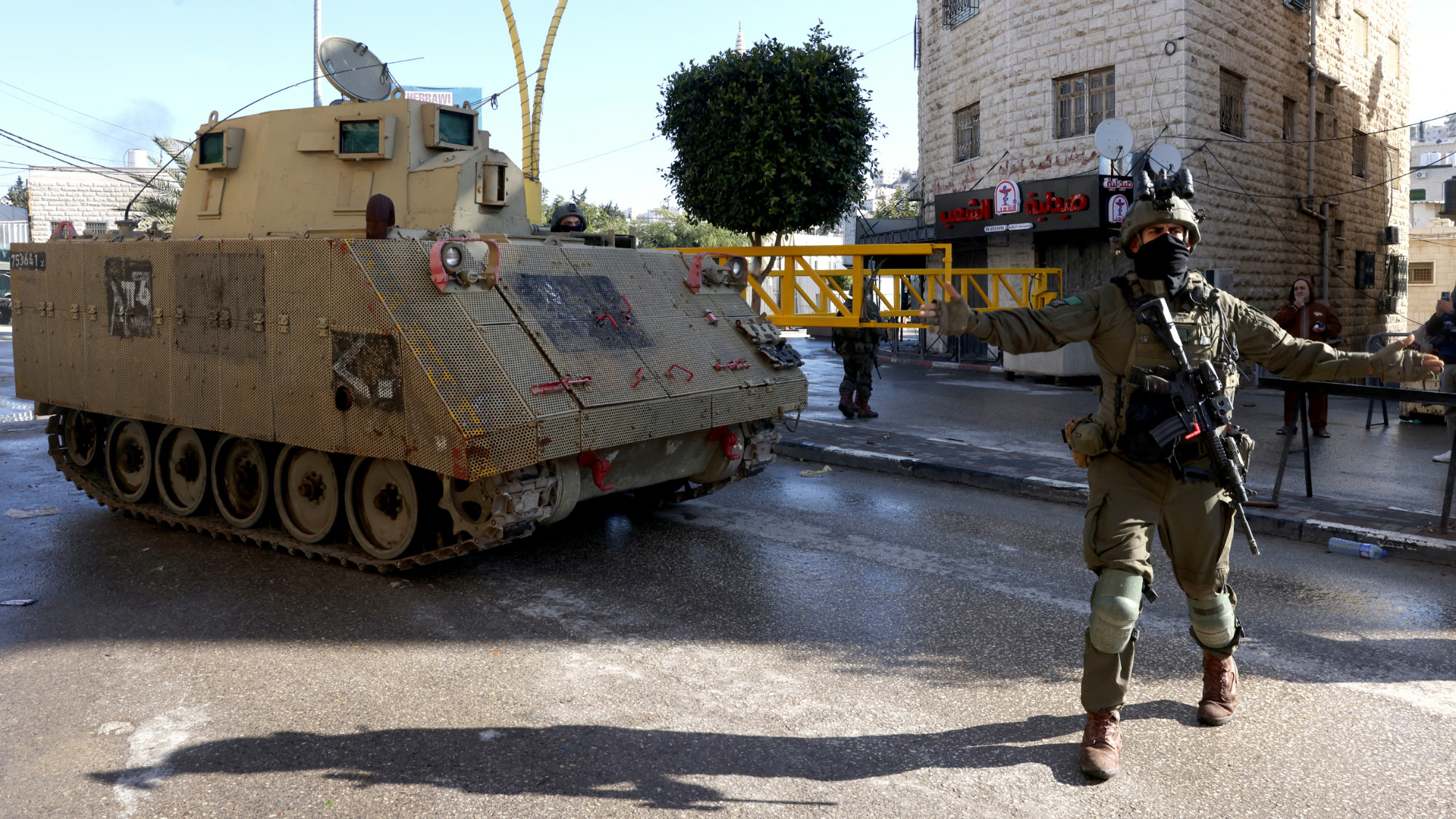
A major Israeli military operation has entered its second day in the occupied West Bank city of Hebron, imposing severe restrictions on Palestinian residents while raising concerns about long-term displacement objectives. The extensive assault involves road closures, home raids, and a comprehensive curfew affecting approximately 18,750 Palestinians across multiple southern neighborhoods including Khilat al-Qubba, Jabal Jawhar, and al-Sahla.
The Israeli military announced the operation would continue for several days, warning residents to expect increased troop movements and audible explosions. According to official statements, the raid aims to confiscate weapons and enhance security through coordinated efforts between the army, police, and border guard units.
Residents report extreme measures including the deployment of military vehicles and bulldozers creating barriers with earth mounds, iron gates, and even repurposed civilian vehicles. A security cordon encompassing approximately four square kilometers has effectively isolated the targeted areas, with concrete blocks and checkpoints sealing all access points.
Local accounts describe intensive house raids, arbitrary arrests, and the occupation of Palestinian homes as military barracks. Farid Burqan, a Jabal Jawhar resident, revealed that the army informed locals of an eight-day curfew minimum, preventing them from leaving their homes. Educational institutions have been shuttered since the operation’s inception, while access to basic necessities and freedom of movement remain severely constrained.
The industrial zone containing several major factories has ceased operations, disrupting livelihoods and economic activity. Lafi Ghaith, a stone factory employee, reported being unable to reach his workplace while his family endured home invasions and property destruction. Many residents interpret the operation as part of a broader strategy to facilitate settlement expansion and Palestinian displacement.
Hebron’s political complexity adds significance to the operation. Under the 1997 Hebron Agreement, the city remains divided into H1 (Palestinian Authority control) and H2 (full Israeli control, including the Old City and Ibrahimi Mosque). For over 25 years, Israel has maintained approximately 120 checkpoints and gates around the mosque area, which houses both Palestinian residents and settlement outposts.
Deputy Mayor Asma Sharabati emphasized the operation targets a densely populated area containing 12 government schools and four municipal service centers. She warned that the assault extends beyond immediate security concerns to broader political objectives, including altering the architectural character of the Ibrahimi Mosque and expanding settlement infrastructure connecting to Kiryat Arba.
The timing coincides with unprecedented restrictions barring the Ibrahimi Mosque’s director and head custodian from entering the holy site for 15 days—a move reminiscent of Jerusalem’s Al-Aqsa Mosque restrictions. This development suggests potential efforts to transfer administrative control from Hebron Municipality to the religious council of Kiryat Arba settlement.
Youth Against Settlements coordinator Issa Amr identified the operation’s core objective as separating eastern and southern areas from central Hebron while depopulating the industrial zone. The absence of arrests targeting known lawbreakers in the area further reinforces concerns about ulterior motives behind the military action.
Local authorities are calling for urgent intervention from the Palestinian Authority and international community, emphasizing Hebron’s unique vulnerability as a city containing settlement outposts within its urban fabric. Any expansion of these outposts could trigger significant Palestinian displacement and complicate territorial control indefinitely.